After a year of calamity, Malaysia Airlines is shrinking to survive.
The disappearance of Flight 370 one year ago, combined with the downing of Flight 17
over a rebel held area of eastern Ukraine four months later, brought
the already financially struggling flag carrier to its knees.
The government, which owned most of the airline, took 100 percent
ownership and removed it from the Malaysian stock exchange last year.
The airline is now aiming to return to profitability by 2017 with a
drastic $1.7 billion overhaul that includes cutting nearly a third of
its staff.
Key to the plan is a new CEO, Christoph Mueller, a turnaround
specialist who led a successful revival of Ireland’s Aer Lingus. His new
bosses hope he’ll be able to pull off a similar feat at Malaysia
Airlines though analysts say success is far from guaranteed because of
the political baggage of being a state-owned company. At least four
other major restructurings of Malaysia Airlines since 2001 have failed.
“There’s no doubt that it’s got more challenges than many, because
you’re dealing with a company that’s in a poor financial state, you’ve
got the political interference, the backlash of the incidents,” said
John Strickland, director of JLS, an airline industry consulting
company.
The challenge of the restructuring is compounded by rapid changes in
the aviation industry in Asia, where low cost carriers are proliferating
to serve the growing ranks of middle class consumers.
The disasters that brought Malaysia Airlines to the brink of
financial collapse served to underline the weakness of it and other
full-service carriers in the region. They face stiff competition from a
wave of budget upstarts including Malaysia’s AirAsia, Indonesia’s Lion
Air, Tigerair and Scoot from Singapore, and Qantas offshoot Jetstar.
Even Malaysia Airlines has its own low-cost offshoot, Firefly.
Mueller may be keen to use it as a testing ground for new ideas, given
his track record at Aer Lingus, where he responded to competition from
no-frills airline Ryanair by mimicking as many of its practices as
possible.
The changes, which blurred the distinction between Lingus and
Ryanair, include shortened airplane turnaround times at the gate and
charging for seat selection, checked bags and food and drinks.
Aer Lingus’ net profit since its 2006 stock flotation has wobbled
between modest profits and losses as the company took financial hits for
strikes, shutdowns, mass cancellations and pension gap payoffs in order
to avoid more strikes.
The result is that he’s turned an airline that was near death into an
attractive takeover target for Ryanair and British Airways parent IAG
simply by getting it through a period of massive upheaval.
A similar outcome might be in store at Malaysia Airlines. Khazanah
Nasional, the Malaysia sovereign investment fund that owns the airline,
said it may consider selling some or all of its stake to private
investors after relisting shares within a planned three to five years.
Aer Lingus and Khazanah Nasional declined interview requests for Mueller, who started his new job on Sunday.
In a quarterly update released Monday, Khazanah said the overhaul of
Malaysia Airlines is on track. The airline is preparing to cut 6,000 of
its 20,000 employees. It’s also planning to expand seats on Asian routes
by 5 percent but is reviewing European and Mideast routes with a view
to ending some.
The company said it also won a temporary 25 percent reduction on its
monthly catering bill as it renegotiates its supplier contract.
The cuts are vital to stem the losses at the airline. In its last
financial result as a listed company, the airline reported that third
quarter losses widened 53 percent from a year earlier to $170.3 million.
That brought its loss in the first nine months of last year to $368
million.
Asian aviation experts have urged changes at the airline but say
there is a risk it could shrink too much as it battles to compete with
the low-cost crowd.
They say there’s still room for legacy carriers in Asia, though they
need to concentrate on routes and destinations where they can make
money, mainly to capital cities and business and finance hubs.
“In Asia, you’ve still got a lot of low-income countries where price
is a major factor,” said Andrew Herdman, director-general of the
Association of Asia-Pacific Airlines. “It’s a challenge for full-service
carriers in Asia to restructure and be more efficient to narrow that
productivity and cost gap with budget carriers.”
Herdman said a “pure no-frills model is not the answer” for airlines
trying to compete. The bulk of their revenue still comes from medium and
long-haul fares and airlines need two to three classes tailored to the
needs of different types of passengers.
An unexpected helping hand for the airline has come from the collapse in the price of oil over the past year.
Mohshin Aziz, aviation analyst at Maybank Kim Eng Securities, said
the airline’s jet fuel bill, which last year amounted to 6.3 billion
ringgit ($1.7 billion), will be cut in half this year, which alone will
help it return to profitability.
But he also worried it might reduce the pressure for change.
Mohshin said he sees a “zombie” future for the airline which will be “alive but barely.”
“They will just be in this perpetual bureaucratic tug of war between the employees, the government and the management.”
Chan reported from Hong Kong. Shawn Pogatchnik in Dublin contributed to this report.
Copyright (2015) Associated Press. All rights reserved. This material
may not be published, broadcast, rewritten, or redistributed.
This article was written by Kelvin Chan and Eileen Ng from The
Associated Press and was legally licensed through the NewsCred publisher
network.
In the year since the vanishing of MH370, I appeared on CNN more
than 50 times, watched my spouse’s eyes glaze over at dinner, and fell
in with a group of borderline-obsessive amateur aviation sleuths. A
million theories bloomed, including my own.
Illustration by Ritterized
The unsettling oddness was there from the first moment, on
March 8, when Malaysia Airlines announced that a plane from Kuala Lumpur
bound for Beijing, Flight 370, had disappeared over the South China Sea
in the middle of the night. There had been no bad weather, no distress
call, no wreckage, no eyewitness accounts of a fireball in the sky—just a
plane that said good-bye to one air-traffic controller and, two minutes
later, failed to say hello to the next. And the crash, if it was a
crash, got stranger from there.
My yearlong detour to Planet MH370
began two days later, when I got an email from an editor at Slate
asking if I’d write about the incident. I’m a private pilot and science
writer, and I wrote about the last big mysterious crash, of Air France 447 in 2009. My story ran on the 12th. The following morning, I was invited to go on CNN. Soon, I was on-air up to six times a day as part of its nonstop MH370 coverage.
There was no intro course on how to be a cable-news expert. The Town
Car would show up to take me to the studio, I’d sign in with reception, a
guest-greeter would take me to makeup, I’d hang out in the greenroom,
the sound guy would rig me with a mike and an earpiece, a producer would
lead me onto the set, I’d plug in and sit in the seat, a producer would
tell me what camera to look at during the introduction, we’d come back
from break, the anchor would read the introduction to the story and then
ask me a question or maybe two, I’d answer, then we’d go to break, I
would unplug, wipe off my makeup, and take the car 43 blocks back
uptown. Then a couple of hours later, I’d do it again. I was spending 18
hours a day doing six minutes of talking.
I soon realized the germ of every TV-news segment is: “Officials say
X.” The validity of the story derives from the authority of the source.
The expert, such as myself, is on hand to add dimension or clarity.
Truth flowed one way: from the official source, through the anchor, past
the expert, and onward into the great sea of viewerdom.
What made MH370 challenging to cover was, first, that the event was unprecedented and technically complex and, second, that the officials were remarkably untrustworthy.
For instance, the search started over the South China Sea, naturally
enough, but soon after, Malaysia opened up a new search area in the
Andaman Sea, 400 miles away. Why? Rumors swirled that military radar had
seen the plane pull a 180. The Malaysian government explicitly denied
it, but after a week of letting other countries search the South China
Sea, the officials admitted that they’d known about the U-turn from day
one.
Of course, nothing turned up in the Andaman Sea, either. But in
London, scientists for a British company called Inmarsat that provides
telecommunications between ships and aircraft realized its database
contained records of transmissions between MH370 and one of its
satellites for the seven hours after the plane’s main communication
system shut down. Seven hours! Maybe it wasn’t a crash after all—if it
were, it would have been the slowest in history.Not that slow crashes
are unprecedented. In 2005, Helios Airways Flight 522 en route from
Cyprus to Athens lost cabin pressure and flew for nearly three hours
with unconscious pilots before the engines failed and it crashed.
Fig. 5. A mysterious metal orb found on a beach in the Maldives
became internet-famous and spawned speculation the plane had wound up
there.
Other views were circulating, too, however.Fig. 5 A Canadian pilot named Chris Goodfellow went viral with his theory that MH370 suffered a fire that knocked out its communications gear and diverted from its planned route in order to attempt an emergency landing. Keith Ledgerwood, another pilot, proposed
that hijackers had taken the plane and avoided detection by ducking
into the radar shadow of another airliner. Amateur investigators pored
over satellite images, insisting that wisps of cloud or patches of
shrubbery were the lost plane. Courtney Love, posting on her Facebook time line a picture of the shimmering blue sea, wrote: “I’m no expert but up close this does look like a plane and an oil slick.”Fig. 6
Fig. 6.
Then: breaking news! On March 24, the Malaysian prime minister, Najib
Razak, announced that a new kind of mathematical analysis proved that
the plane had in fact gone south. This new math involved another aspect
of the handshakes called the burst frequency offset, or BFO, a measure
of changes in the signal’s wavelength, which is partly determined by the
relative motion of the airplane and the satellite. That the whole
southern arc lay over the Indian Ocean meant that all the passengers and
crew would certainly be dead by now. This was the first time in history
that the families of missing passengers had been asked to accept that their loved ones were dead
because a secret math equation said so. Fig. 7 Not all took it well. In
Beijing, outraged next-of-kin marched to the Malaysian Embassy, where
they hurled water bottles and faced down paramilitary soldiers in riot
gear.
Fig. 7. Making matters worse, the Malaysians informed some of the passengers by text message.Guided by Inmarsat’s calculations, Australia, which was coordinating the investigation, moved the search area 685 miles to the northeast, to a
123,000-square-mile patch of ocean west of Perth. Ships and planes
found much debris on the surface, provoking a frenzy of BREAKING NEWS
banners, but all turned out to be junk. Adding to the drama was a
ticking clock. The plane’s two black boxes had an ultrasonic sound
beacon that sent out acoustic signals through the water. (Confusingly,
these also were referred to as “pings,” though of a completely different
nature. These new pings suddenly became the important ones.) If
searchers could spot plane debris,
they’d be able to figure out where the plane had most likely gone down,
then trawl with underwater microphones to listen for the pings. The problem was that the pingers had a battery life of only 30 days.
On April 4, with only a few days’ pinger life remaining, an
Australian ship lowered a special microphone called a towed pinger
locator into the water.Fig. 8 Miraculously, the ship detected four
pings. Search officials were jubilant, as was the CNN greenroom.
Everyone was ready for an upbeat ending.
Fig. 8.
Photo: Government of Malaysia
The only Debbie Downer was me. I pointed out that the pings were at
the wrong frequency and too far apart to have been generated by
stationary black boxes. For the next two weeks, I was the odd man out on
Don Lemon’s six-guest panel blocks, gleefully savaged on-air by my
co-experts.
The Australians lowered an underwater robotFig. 9 to scan the seabed
for the source of the pings. There was nothing. Of course, by the rules
of TV news, the game wasn’t over until an official said so. But things
were stretching thin. One night, an underwater-search veteran taking
part in a Don Lemon panel agreed with me that the so-called
acoustic-ping detections had to be false. Backstage after the show, he
and another aviation analyst nearly came to blows. “You don’t know what
you’re talking about! I’ve done extensive research!” the analyst
shouted. “There’s nothing else those pings could be!”
Fig. 9.
Photo: Bluefin Robotics
Soon after, the story ended the way most news stories do: We just
stopped talking about it. A month later, long after the caravan had
moved on, a U.S. Navy officer said publicly that the pings had not come
from MH370. The saga fizzled out with as much satisfying closure as the final episode of Lost.
The Search for MH370
Once the surface search was called off, it was the rabble’s turn. In late March, New Zealand–based space scientist Duncan Steel began posting a series of essays
on Inmarsat orbital mechanics on his website.Fig. 10 The comments
section quickly grew into a busy forum in which technically
sophisticated MH370 obsessives answered one another’s questions and
pitched ideas. The open platform attracted a varied crew, from the
mostly intelligent and often helpful to the deranged and abusive.
Eventually, Steel declared that he was sick of all the insults and shut
down his comments section. The party migrated over to my blog, jeffwise.net.
Fig. 10. It was Steel who very early on realized that the
satellite that MH370 was communicating with, 3F-1, was not truly
geostationary but wobbled in its orbit, a crucial detail upon which the
whole story would turn out to hinge. This image shows the path the
satellite took during MH370’s final six hours.
Meanwhile, a core of engineers and scientists had split off via group
email and included me. We called ourselves the Independent Group,Member
roster: Brian Anderson, Sid Bennett, Curon Davies, Pierre-Michel
Decombeix, Michael Exner, Tim Farrar, Yap Fook Fah, Richard Godfrey, Bob
Hall, Bill Holland, Geoff Hyman, Victor Iannello, Barry Martin, L. Rand
Mayer, Henrik Rydberg, Duncan Steel, Don Thompson, and me. or IG. If
you found yourself wondering how a satellite with geosynchronous orbit
responds to a shortage of hydrazine, all you had to do was ask.Answer:
It starts to wobble, creating an error in the frequency of received
signals from which scientists can later attempt to extract clues about
an airplane’s motion. The IG’s first big break came in late May, when
the Malaysians finally released the raw Inmarsat data.
By combining the data with other reliable information, we were able to
put together a time line of the plane’s final hours: Forty minutes after
the plane took off from Kuala Lumpur, MH370 went electronically dark.
For about an hour after that, the plane was tracked on radar following a
zigzag course and traveling fast. Then it disappeared from military
radar. Three minutes later, the communications system logged back onto
the satellite. This was a major revelation. It hadn’t stayed connected,
as we’d always assumed. This event corresponded with the first satellite
ping. Over the course of the next six hours, the plane generated six
more handshakes as it moved away from the satellite.
The final handshake wasn’t completed. This led to speculation that
MH370 had run out of fuel and lost power, causing the plane to lose its
connection to the satellite. An emergency power system would have come
on, providing enough electricity for the satcom to start reconnecting
before the plane crashed. Where exactly it would have gone down down was
still unknown—the speed of the plane, its direction, and how fast it
was climbing were all sources of uncertainty.
The MH370 obsessives continued attacking the problem. Since I was the
proprietor of the major web forum, it fell on me to protect the fragile
cocoon of civility that nurtured the conversation. A single troll could
easily derail everything. The worst offenders were the ones who seemed
intelligent but soon revealed themselves as Believers. They’d seized on a
few pieces of faulty data and convinced themselves that they’d
discovered the truth. One was sure the plane had been hit by lightning
and then floated in the South China Sea, transmitting to the satellite
on battery power. When I kicked him out, he came back under aliases. I
wound up banning anyone who used the word “lightning.”
While jubilation rang through the email threads, I nursed a
guilty secret: I wasn’t really in agreement. For one, I was bothered by
the lack of plane debris. And then there was the data. To fit both the
BTO and BFO data well, the plane would need to have flown slowly, likely
in a curving path. But the more plausible autopilot settings and known
performance constraints would have kept the plane flying faster and more
nearly straight south. I began to suspect that the problem was with the
BFO numbers—that they hadn’t been generated in the way we
believed.Others were having doubts, too, including Tim Clark, the
presidents of Emirates Airlines, which operates more 777s than any other
company in the world. “We have not seen a single thing that suggests
categorically that this aircraft is where they say it is,” Clark said in
an interview with Der Spiegel. If that were the case, perhaps the flight had gone north after all.
For a long time, I resisted even considering the possibility that
someone might have tampered with the data. That would require an almost
inconceivably sophisticated hijack operation, one so complicated and
technically demanding that it would almost certainly need state-level
backing. This was true conspiracy-theory material.
I realized that I already had a clue that hijackers had been in the
E/E bay. Remember the satcom system disconnected and then rebooted three
minutes after the plane left military radar behind. I spent a great
deal of time trying to figure out how a person could physically turn the
satcom off and on. The only way, apart from turning off half the entire
electrical system, would be to go into the E/E bay and pull three
particular circuit breakers. It is a maneuver that only a sophisticated
operator would know how to execute, and the only reason I could think
for wanting to do this was so that Inmarsat would find the records and
misinterpret them. They turned on the satcom in order to provide a false
trail of bread crumbs leading away from the plane’s true route.
It’s not possible to spoof the BFO data on just any plane. The plane
must be of a certain make and model, Has to be one of the newer models
of Boeing; in Airbus jets the E/E bay hatch is inaccessible from the
passenger cabin, and older Boeing planes lack the ability to
autoland.equipped with a certain make and model of
satellite-communications equipment,A crucial piece of satcom hardware,
the satellite data unit, must be built by Honeywell/Thales, not its
competitor, Raytheon, for this to work. and flying a certain kind of
routeOne that begins near the equator and heads in a direction opposite
to a large body of water. in a region covered by a certain kind of
Inmarsat satellite.One that is running low on fuel. If you put all the
conditions together, it seemed unlikely that any aircraft would satisfy
them. Yet MH370 did.
I imagine everyone who comes up with a new theory, even a complicated
one, must experience one particularly delicious moment, like a perfect
chord change, when disorder gives way to order. This was that moment for
me. Once I threw out the troublesome BFO data, all the inexplicable
coincidences and mismatched data went away. The answer became
wonderfully simple. The plane must have gone north.
Using the BTO data set alone, I was able to chart the plane’s speed
and general path, which happened to fall along national borders.Fig. 21
Flying along borders, a military navigator told me, is a good way to
avoid being spotted on radar. A Russian intelligence plane nearly
collided with a Swedish airliner while doing it over the Baltic Sea in
December. If I was right, it would have wound up in Kazakhstan, just as
search officials recognized early on.
Fig. 21. In particular, the flight path skirts the border of
China and just misses the disputed and much-watched India-Pakistan
border.
Fig. 22.
Photo: Jeff Wise
There aren’t a lot of places to land a plane as big as the 777, but,
as luck would have it, I found one: a place just past the last handshake
ring called Baikonur Cosmodrome.Fig. 22 Baikonur is leased from
Kazakhstan by Russia. A long runway there called Yubileyniy was built
for a Russian version of the Space Shuttle. If the final Inmarsat ping
rang at the start of MH370’s descent, it would have set up nicely for an
approach to Yubileyniy’s runway 24.
Fig. 23: To the best of my knowledge, this airstrip is
the only one in the world built specifically for self-landing airplanes.
The 777, which was developed in the ’90s, has the ability to autoland.
From a hijacking perspective, this feature allows people who don’t have
commercial-piloting experience to abscond with an airplane and get it
safely on the ground, so long as they know what autopilot settings to
input.
If MH370 did land at Yubileyniy, it had 90 minutes to
either hide or refuel and takeoff again before the sun rose. Hiding
would be hard. This part of Kazakhstan is flat and treeless, and there
are no large buildings nearby. The complex has been slowly crumbling for
decades, with satellite images taken years apart showing little change,
until, in October, 2013, a disused six-story building began to be
dismantled. Next to it appeared a rectangle of bulldozed dirt with a
trench at one end.
What got my attention was the size of the thing. I’ve added the silhouette of a 777 for scale.
Work proceeded deep into the winter. In the four days
before the following image was taken on January 9, 2014, the temperature
fluctuated between -15F and +14F.
By March, the building was gone and everything had been bulldozed flat. Eight days after MH370 vanished, it looked like this.
Construction
experts told me these images most likely show site remediation: taking
apart a building and burying the debris. Yet why, after decades, did the
Russians suddenly need to clear this one lonely spot, in the heart of a
frigid winter, finishing just before MH370 disappeared?Whether the plane went to Baikonur or elsewhere in
Kazakhstan, my suspicion fell on Russia. With technically advanced
satellite, avionics, and aircraft-manufacturing industries, Russia was a
paranoid fantasist’s dream.At the time of MH370’s disappearance, he had
just used special forces to annex Crimea and was running civil war by
proxy in eastern Ukraine via military intelligence. (The Russians, or at
least Russian-backed militia, were also suspected in the downing of
Malaysia Flight 17 in July.) Why, exactly, would Putin want to steal a
Malaysian passenger plane? I had no idea. Maybe he wanted to demonstrate
to the United States, which had imposed the first punitive sanctions on Russia
the day before, that he could hurt the West and its allies anywhere in
the world. Maybe what he was really after were the secrets of one of the
plane’s passengers.Aboard the flight were 20 employees of Freescale
Semiconductor, which develops processors and sensors for the “Internet
of Things.” Maybe there was something strategically crucial in the hold.
Or maybe he wanted the plane to show up unexpectedly somewhere someday,
packed with explosives. There’s no way to know. That’s the thing about
MH370 theory-making: It’s hard to come up with a plausible motive for an
act that has no apparent beneficiaries.
As it happened, there were three ethnically Russian men aboard MH370,
two of them Ukrainian-passport holders from Odessa.All were in their
mid-40s, old enough to be experienced, young enough for vigorous
action—about the same age as the military-intelligence officer who was
running the show in eastern Ukraine. Could any of these men, I wondered, be special forces or covert operatives?
As I looked at the few pictures available on the internet, they
definitely struck me as the sort who might battle Liam Neeson in midair.
Fig. 27. I was later able to confirm that they worked for
Nika-Mebel, an Odessa furniture company that sells online only, accepts
only cash payment, provides no landline number or address, and had no
content on its website before 2013. Both Nika-Mebel and the men’s
families refused to talk to me. This picture of the men was posted by a
friend on VK.com, the Russian version of Facebook.
About the two Ukrainians, almost nothing was available online.Fig. 27
I was able to find out a great deal about the Russian,Fig. 28 who was
sitting in first class about 15 feet from the E/E-bay hatch.Fig. 29 He
ran a lumber company in Irkutsk, and his hobby was technical diving
under the ice of Lake Baikal.His dive club’s annual New Year’s party under the ice. [video]
I hired Russian speakers from Columbia University to make calls to
Odessa and Irkutsk, then hired researchers on the ground.When MH17 was
shot down, it seemed to so perfectly tie the bow between the Ukraine war
and the other Malaysia Airlines 777 that I was terrified I’d gotten my
freelancer in Irkutsk in deep trouble; I texted her, and she replied
that she was fine. She didn’t seem concerned.
Fig. 28.
The more I discovered, the more coherent the story seemed to me.In fact, I wrote the whole thing up in an e-book, The Plane That Wasn’t There: Why We Haven’t Found MH370. [amazon]
I found a peculiar euphoria in thinking about my theory, which I
thought about all the time. One of the diagnostic questions used to
determine whether you’re an alcoholic is whether your drinking has
interfered with your work. By that measure, I definitely had a problem.
Once the CNN checks stopped coming, I entered a long period of intense
activity that earned me not a cent. Instead, I was forking out my own
money for translators and researchers and satellite photos. And yet I
was happy.
Fig. 29. At position B. The Ukrainians were at D and C—underneath the satellite antenna.
Photo: Seatguru
Still, it occurred to me that, for all the passion I had for my
theory, I might be the only person in the world who felt this way.
Neurobiologist Robert A. Burton points out in his book On Being Certain
that the sensation of being sure about one’s beliefs is an emotional
response separate from the processing of those beliefs. It’s something
that the brain does subconsciously to protect itself from wasting
unnecessary processing power on problems for which you’ve already found a
solution that’s good enough. “ ‘That’s right’ is a feeling you get so
that you can move on,” Burton told me. It’s a kind of subconscious
laziness. Just as it’s harder to go for a run than to plop onto the
sofa, it’s harder to reexamine one’s assumptions than it is to embrace
certainty. At one end of the spectrum of skeptics are scientists, who by
disposition or training resist the easy path; at the other end are
conspiracy theorists, who’ll leap effortlessly into the sweet bosom of
certainty. So where did that put me?
Propounding some new detail of my scenario to my wife over dinner one
night, I noticed a certain glassiness in her expression. “You don’t
seem entirely convinced,” I suggested.
She shrugged.
“Okay,” I said. “What do you think is the percentage chance that I’m right?”
“I don’t know,” she said. “Five percent?”I recently reminded her of
this conversation. “I was trying to be nice,” she said. What she really
thought was, Zero.
Springtime came to the southern ocean, and search vessels
began their methodical cruise along the area jointly identified by the
IG and the ATSB, dragging behind it a sonar rig that imaged the seabed
in photographic detail. Within the IG, spirits were high. The discovery
of the plane would be the triumphant final act of a remarkable underdog
story.
By December, when the ships had still not found a thing, I felt it
was finally time to go public. In six sequentially linked pages that
readers could only get to by clicking through—to avoid anyone reading
the part where I suggest Putin masterminded the hijack without first
hearing how I got there—I laid out my argument. I called it “The Spoof.”
I
got a respectful hearing but no converts among the IG. A few sites
wrote summaries of my post. The International Business Times headlined
its story “MH370: Russia’s Grand Plan to Provoke World War III, Says
Independent Investigator” and linked directly to the Putin part.
Somehow, the airing of my theory helped quell my obsession. My gut still
tells me I’m right, but my brain knows better than to trust my gut.
Last month, the Malaysian government declared that the aircraft is considered to have crashed and all those aboard are presumed dead.
Malaysia’s transport minister told a local television station that a
key factor in the decision was the fact that the search mission for the
aircraft failed to achieve its objective. Meanwhile, new theories are
still being hatched. One, by French writer Marc Dugain, states
that the plane was shot down by the U.S. because it was headed toward
the military bases on the islands of Diego Garcia as a flying bomb.His
scenario ignores the ping rings entirely.
The search failed to deliver the airplane, but it has accomplished
some other things: It occupied several thousand hours of worldwide
airtime; it filled my wallet and then drained it; it torpedoed the idea
that the application of rationality to plane disasters would inevitably
yield ever-safer air travel. And it left behind a faint, lingering itch
in the back of my mind, which I believe will quite likely never go away.
THE HAGUE – Dutch air crash investigators said Monday they
expect to release an initial report into what brought down flight MH17
over Ukraine with the loss of 298 lives “in a few weeks”.
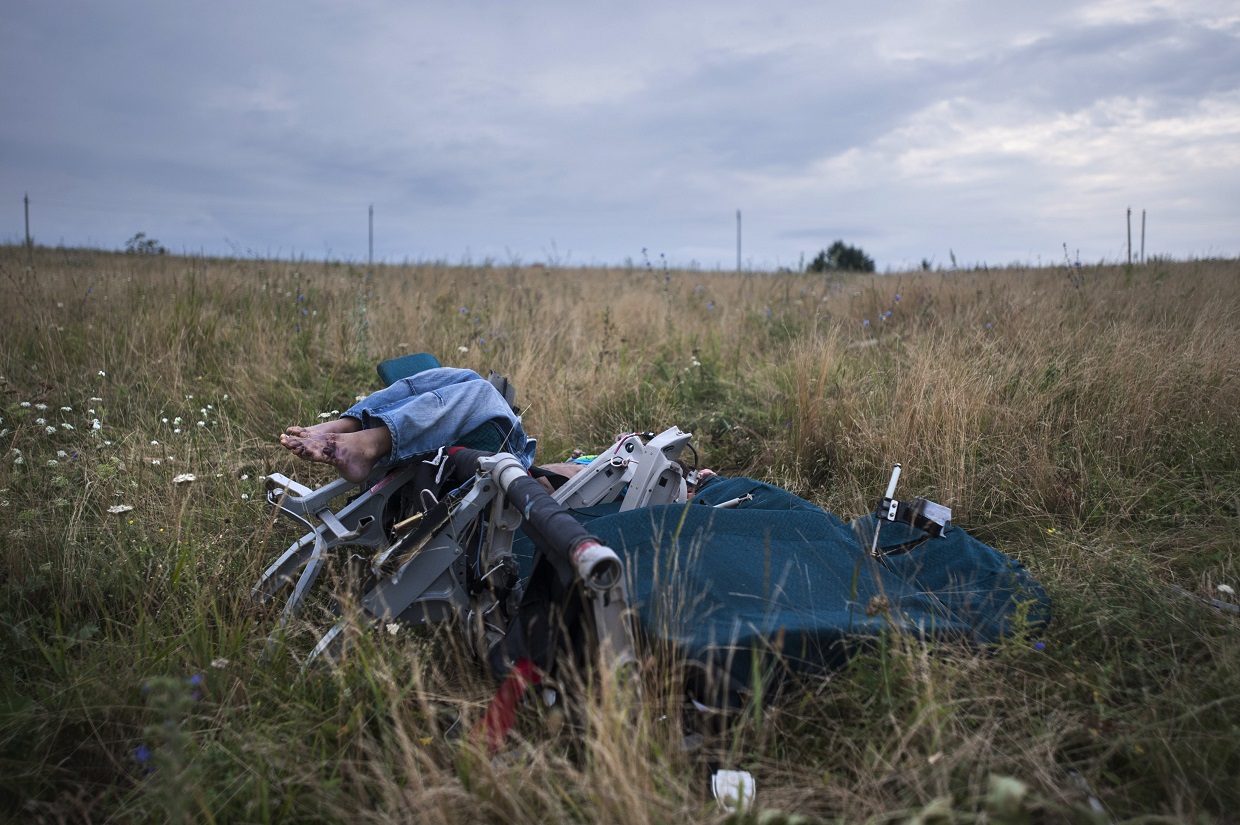
A body sitting in a plane chair is seen at the crash site of a Malaysia
Airlines jet near the village of Hrabove, eastern Ukraine, Saturday. AP
There were 193 Dutch citizens aboard the Malaysia Airlines 777 when
it exploded over strife-torn eastern Ukraine on July 17 and the Dutch
are in charge of victim identification and probing the cause of the
disaster.
The West has accused pro-Russian separatists of shooting down the
jet with a missile supplied by Russia. Moscow has accused Ukraine of
shooting it down.
“We have sufficient information to compile a preliminary report,”
said Wim van der Weegen, spokesman for the Dutch Safety Board (OVV).
“We hope that it will be ready in a few weeks,” he told AFP,
announcing that international crash investigators had now returned to
the Netherlands without visiting the crash site.
“In order to analyze the information… it’s not essential to
remain in Ukraine,” Van der Weegen told AFP, saying the team will now be
based in The Hague.
Ukranian air crash experts, who are taking part in the
international probe, had been at the crash site shortly after the crash,
before the Dutch were tasked with leading the investigation, Van der
Weegen said.
The deteriorating security situation prevented crash
investigators under the OVV’s leadership from reaching the remote site,
although Dutch, Australian and Malaysian forensic experts did reach the
area to look for body parts and personal belongings.
“Since we’ve taken over the investigation, there has been no new opportunity to get to the crash site,” Van der Weegen said.
The OVV said in a statement that it was only investigating what brought down flight MH17, not who was responsible.
Dutch Prime Minister Mark Rutte last Wednesday called off the
search for body parts as a result of escalating fighting between Kiev
and pro-Russian separatists.
Van der Weegen said enough sources were available including
cockpit voice recorders, flight data recorders (black boxes), radar
details and information from air traffic controllers.
“We have enough information (for a preliminary report), but we
would like to return to the crash site to verify some of our findings
and get additional information,” he said.
The coffins will be given the same military honours as the 40 coffins that arrived on Wednesday
THE HAGUE, Netherlands - Planes carrying more bodies recovered from
the MH17 crash site in Ukraine were flown to the Netherlands on
Thursday, a day after the first of the 298 dead arrived.
Two planes carrying a total of 74 coffins landed at Eindhoven in the
south of the country, from where they are to be taken to a military
barracks in Hilversum, near Amsterdam, for forensic examination and
identification.
The coffins will be given the same military honours as the 40 coffins that arrived on Wednesday.
They will be placed in individual hearses as during the ceremony Wednesday, a Dutch national day of mourning.
The Netherlands lost 193 citizens in the crash, and is also heading
the investigation of the other dead from a total of 11 countries.
Dutch police said that 80 forensic experts from Germany, Belgium,
Britain, Australia, Indonesia, New Zealand, and Malaysia were helping
120 Dutch with the task of identification, which could take months. - Rappler.com
DONETSK, Ukraine — In an interview with Reuters
on Wednesday, Alexander Khodakovsky, commander of the Russian-backed
Vostok Battalion, admitted that rebels possessed a BUK missile system —
the same system Kiev and Western intelligence agencies say downed Malaysia Airlines Flight 17 in eastern Ukraine.
“I knew that a BUK came from Luhansk. At the time I was told that a BUK
from Luhansk was coming under the flag of the LNR,” Reuters quoted him
as saying, referring to the Luhansk People’s Republic, one of two rebel
strongholds in eastern Ukraine. They also control the eastern region of Donetsk.
However, Khodakovsky, a former Ukrainian security services officer
turned separatist commander, called out the news agency shortly after it
published the exclusive interview, saying the quote had been fabricated.
In a telephone interview with Russia’s LifeNews, he admitted to
speaking with Reuters about the BUK, but came short of an all-out denial that he had acknowledged rebels had a system in their possession.
"We had a conversation with the agency that published this information. We
discussed the various versions. One of the versions has been the
accusation [of possessing the BUK missile system]...
As commander of the militia, if I possessed such a tool, I'd never have used it
As commander of the militia, if I possessed such a tool,
I'd never have used it. None of the officers would have gone to such
irrational use... In the interview I outlined this information,"
Khodakovsky said.
“I did not say anything like this to Reuters,
and I have a recording of a conversation," Russia’s RIA Novosti reported
a source close to Khodakovsky as saying.
Reuters, however, released audio of the tape
hours later. In a clip carried and translated by Radio Free
Europe/Radio Liberty, a voice resembling that of Khodakovsky
acknowledges that a BUK missile system was in the possession of the
rebels, just as the news agency had reported.
“We stand by our story,”
“We stand by our story,” David Crundwell, a corporate affairs officer for Reuters, told Mashable via email.
Ukrainian and Western intelligence believe it was a Soviet-made BUK surface-to-air missile system that downed the Boeing 777 as it passed over the eastern region of Donetsk on July 17, killing all 298 passenger on board.
U.S. intelligence officials this week blamed Russia for backing the rebels,
who they say are likely the culprits behind the downing of the plane.
However, the unnamed senior officials say the Russian government wasn't directly involved in the shooting. They believe the rocket was fired from an area on the outskirts of the city of Snezhnoe.
Before the Malaysian plane was shot down, rebels had loudly boasted
of have BUK missiles in their possession, and several amateur
photographs and videos — one embedded below from the Reuters reporter
who interviewed the rebel leader — appeared to show it moving through
rebel-controlled territory.
The advanced rocket system can shoot down planes at heights up to 72,000 feet, according to analysts at HIS Jane’s, a defense consultancy.
Flight 17 was cruising at an altitude of about 33,000 feet when it was hit.
Since the disaster, the rebels have categorically denied ever possessing
the system.
In the interview, Reuters also reported Khodakovsky
as saying the BUK missile system may have originated in Russia and could
have returned there after the jetliner was shot down to remove proof of
its presence.
Mashable's attempts to contact the authors of the Reuters story and Khodakovsky were unsuccessful.
Khodakovsky, a former head of the Security Service of Ukraine’s elite “Alpha”
anti-terrorism unit in Donetsk, clashed with anti-government protesters
in Kiev during the Euromaidan Revolution that toppled former President
Viktor Yanukovych in February. He’s one the few rebel commanders
operating in Donetsk and Luhansk regions that is a Ukrainian citizen.
One reason for his admission could be due to his recent quarrels with other rebel commanders.
One reason for his admission could be due to his recent quarrels with other rebel commanders.
The rebel militias have been plagued by infighting for weeks. On July 16,
one day before the Malaysia Airlines jet was shot down, Khodakovsky was
purportedly forced to resign from his post as security minister for the self-proclaimed Donetsk People’s Republic.
Previously, he had butted heads with the breakaway republic’s self-described
defense minister Igor Strelkov, a Muscovite who, on the day the plane
was shot down, wrote — and then retracted — “We warned you — do not fly in our sky.”
TV reporters rely on a lot of cliché metaphors in their job —
e.g., “seeds of doubt,” “flurry of activity” — but when you’re reporting
on a particularly grisly story, you may want to think twice about which
ones you employ.
For this particular example of Cliches Not to Use When Reporting™, we turn to CNN’s Chris Cuomo,
who appeared Monday live from the crash site of Malaysia Airlines
Flight 17, the passenger flight that reportedly fell victim to a
surface-to-air missile of undetermined origin, killing all 298 aboard:
In case you’re too lazy to un-mute the above Vine, Cuomo asked Rep. Mike Rogers (R-MI) to “shoot down” a theory about the missiles having potentially been used by the Ukrainian forces to take down MH17.
To his credit, Cuomo quickly noticed his own poor phrasing and said “Excuse the pun.”
The fact that no one is placing blame on Malaysia Airlines for what happened to MH17 last week is not stopping the airline from offering full refunds to those who wish to cancel their future flights.
Passengers have until Thursday, July 24th, to make adjustments to their
itineraries without a change fee, and even get reimbursed for a
non-refundable ticket. The offer applies to flights scheduled now
through the end of the calendar year.
If you have a ticket but feel like you need some time before you fly
again, call the MH Global Call Center at 1-300-88-3000. Remember, all
changes must be made by this Thursday, July 24th.
Malaysia Airlines flight MH17 takes off at 12.31 PM from Schiphol airport near Amsterdam. Photograph: Fred Neeleman/EPA
Malaysia
Airlines flight MH17 was guided off its most recently used course as
its pilots hoped to avoid thunderstorms brewing in the south of Ukraine, it has been claimed.
When
it was shot down, the doomed jet was many miles north of the flight
paths it had used on previous days to Kuala Lumpur from Amsterdam's
Schiphol airport.
Nico Voorbach, a pilot who flew the same journey
earlier this summer for KLM, and who is president of the European
Cockpit Association, said poor weather might have been the reason why
flight MH17 found itself in the sights of a surface-to-air missile
launcher. The aircraft was shot down in the separatist Donetsk region of
east Ukraine.
Voorbach said: "I heard that they were diverting
from some showers. I think there were thunderclouds. You would ask air
traffic control to divert left or right, and they would give you the
permission."
It also emerged that flight MH17 had initially filed a
flight plan requesting to fly at 35,000ft above Ukrainian territory. On
entering Ukrainian airspace, however, the plane's pilots were
instructed to fly at 33,000ft by the local air traffic control due to
other traffic. Malaysia Airlines said the pilots had to follow the lead
of the local authorities.
Malaysia's transport minister, Datuk
Seri Liow Tiong Lai, told a press conference: "MH17's flight path was a
busy major airway, like a highway in the sky. It followed a route which
was set out by the international aviation authorities, approved by
Eurocontrol, and used by hundreds of other aircraft.
"MH17 flew at
an altitude that was set and deemed safe by local air traffic control,
and it never strayed into restricted airspace. The flight and its
operators followed the rules. But on the ground, the rules of war were
broken."
In response to claims that weather led to MH17 changing
its flight plan, Malaysia Airlines director of operations Izham Ismail
said that it had no reports from the pilot to suggest that this was the
case. The airline has been keen to stress that after the International
Civil Aviation Organisation in April identified an area over the Crimea
peninsula as risky, its aircraft had "at no point" flown into or
requested to fly into the area. The tragedy has, however, raised
questions over the wisdom of commercial airlines continuing to fly over
conflict zones.
Airlines currently take their cue on risk from
national governments, who are responsible for the airspace over their
territories, although states have an interest in keeping flight paths
open because they are able to collect overflight fees.
The UK
Civil Aviation Authority recently urged UK-based airlines not to fly
over a wide area near the Crimea, Black Sea and Sea of Azov, and several
airlines, including British Airways, have followed that advice.
Others,
however, had been continuing to use the route, which is one of the
"aerial motorways" between northern Europe and south Asia. Malaysia
Airlines was one of more than a dozen that flew the route on Thursday.
Its flight MH17 was only a few miles from an Air India Boeing 787 and a
Singapore Airlines 777 when it was shot down. The only restriction
placed on the route by the Ukrainian government was that aircraft must
remain above 32,000ft.
Voorbach said that the European Cockpit
Association, which represents 38,000 pilots at the EU level, would
discuss the possibility of more rigorous rules this week at its next
board meeting. He added that there might now be an argument for a total
ban on flying over conflict zones, but that the repercussions of such a
change, including longer flight times and extra costs to airlines, could
be huge for the aviation industry.
He said: "Do we stop planes
flying over Israel, for example? Looking across the world, stopping
flights over conflict zones would add a huge burden to the aviation
industry. We need to see what the inquiry into the disaster discovers. I
just hope that politics does not get in the way of the inquiry."
Since the crash, all airspace in eastern Ukraine has been closed.
Anger grows in EU and leaders prepare fresh sanctions against Moscow as separatists obstruct access to crash site
Prime minister David Cameron is said to be furious at how
long it took Vladimir Putin to respond to his request for a
conversation. Photograph: Max Nash/PA
David Cameron expressed anger about the shooting down of Malaysia Airlines flight MH17 in a telephone conversation with Vladimir Putin on Sunday as EU leaders started preparing fresh sanctions against Moscow for its alleged role in the attack.
Ten
Britons died when flight MH17 was shot down with a missile on Thursday
and sources indicated that Cameron was furious that it took the Russian
president three days to respond to his request for a telephone
conversation.
"We
have enormous input about this that points fingers," Kerry told CNN.
"It is pretty clear that this was a system from Russia, transferred to
separatists. We know with confidence that the Ukrainians did not have
such a system anywhere near the vicinity at that point of time."
He
said satellite imagery showed that "at the moment of the shootdown we
detected a launch from that area. Our trajectory shows that it went to
the aircraft."
Kerry added that video evidence showed a Buk missile launcher,
the anti-aircraft weapon believed to have hit the airliner, being
driven over the Russian border after the attack, with at least one of
its missiles missing.
After the call between Cameron and Putin,
Downing Street said: "The prime minister spoke to President Putin this
evening and made clear that the shooting down of MH17 was totally
unacceptable. The evidence suggested that pro-Russian separatists were
responsible and the prime minister made clear that if Russia wants to
put the blame elsewhere they would need to present compelling and
credible evidence.
"The PM made clear that our priority is to get
experts to the crash site so they can recover and repatriate the victims
and collect any evidence necessary for the investigation. The PM
emphasised that the families of 298 individuals need to know that
everything is being done to make this happen and called on President
Putin to use his influence on the pro-Russian separatists to ensure this
happens. The delay and restrictions so far were completely unacceptable
and indefensible."
Earlier,
Cameron, who will make a statement to MPs about the crisis , spoke to
the Angela Merkel, the German chancellor, and François Hollande, the
French president. The three leaders agreed that "the EU must reconsider
its approach to Russia" and that EU foreign ministers would consider
further sanctions at a meeting on Tuesday, No 10 said.
A
government source said the French and German position on sanctions had
shifted since last week. "They are all very clear that a plane has been
shot out of the sky and that all the evidence points to it being the
work of Russian separatists, and that therefore the EU should impose
further measures," the source said.
In an interview on the BBC's
the World this Weekend, Philip Hammond, the new foreign secretary, said a
range of measures would be considered.
"Arms sales is something
we need to look at," he said. "An investment ban on investment in the
Crimea, sending a clear signal that we will not tolerate the illegal
annexation of Crimea, broadening the number of individuals who are
subject to sanctions to include the so-called 'crony group' around
President Putin."
Monitors from the Organisation for Security and Cooperation in Europe, who have been in eastern Ukraine
to observe the conflict between government and rebel forces, have been
allowed on the scene, a few miles east of Donetsk, but specialist air
crash investigators from around the world were still in Kiev on Sunday
night, awaiting guarantees of safe passage to the site.
Dianne
Feinstein, the head of the Senate foreign relations committee in the US,
said: "The nexus between Russia and the separatists has been
established very clearly." In a direct and personal challenge to the
Russian premier, she added: "So the issue is, where is Putin? I would
say, Putin you have to man up. You have to say this was a mistake, which
I hope it was."
The Ukrainian president, Petro Poroshenko, spent
the day calling western leaders to ask them to list the main rebel
organisation in the east of the country, the Donetsk People's Republic
(DNR), as a terrorist organisation, which would mean that any country
providing support would risk being sanctioned as a state sponsor of
terrorism.
In a conversation with Hollande, Poroshenko said the
downing of MH17 was comparable with terrorist attacks by al-Qaida and
the 1988 bombing of Pan Am flight 103.
The EU has already imposed
sanctions on 72 people – both Ukrainian and Russian nationals – and two
organisations for violating Ukrainian territorial integrity. One of
those on the list is Igor Strelkov, the DNR's "defence minister", who
Ukraine says is a serving officer in Russian military intelligence named
Igor Girkin.
The toughest line at Tuesday's foreign ministers
meeting in Brussels is likely to come from the British and French, but
most of all from the Dutch, who have lost 192 of their citizens.
The
UN security council was last night considering a draft resolution to
condemn the shooting down of the plane, demand armed groups allow
unfettered access to the crash site, and call on states in the region to
cooperate with an investigation.
Australia despatched its foreign
minister, Julie Bishop, to New York to push for a UN Security Council
resolution. It is unclear whether Russia intends to veto it.
Australia
– which lost 28 citizens – circulated a draft text to the 15-member
security council and UN diplomats said it could be put to a vote as
early as Monday.
The draft resolution "condemns in the strongest
terms the shooting down of Malaysia Airlines flight MH17 ... resulting
in the tragic loss of 298 lives" and demands those responsible "be held
to account and that all states cooperate fully with efforts to establish
accountability".
It "expresses grave concern at reports of
insufficient and limited access to the crash site and of tampering with
evidence related to the incident" and demands "armed groups in control
of the crash site and the surrounding area refrain from any actions that
may compromise the integrity of the crash site and immediately provide
safe, secure, full and unfettered access."
Australia's prime
minister, Tony Abbott, said that Bishop would stay at the UN "for as
long as she needs to be" to get investigators access to the black box,
the debris and witnesses.
"We owe it to the dead, all the dead, we
owe it to the families, all the families to do everything in our power
to respect the bodies, to find the truth and to ensure justice is done,"
Abbott said in a television interview.
Pro-Russian
fighters walk on a road with victims’ bodies lying in bags by the side
at the crash site of a Malaysia Airlines jet near the village of
Hrabove, eastern Ukraine, Saturday, July 19, 2014. Ukraine accused
Russia on Saturday of helping separatist rebels destroy evidence at the
crash site of a Malaysia Airlines plane shot down in rebel-held
territory — a charge the rebels denied. AP
WASHINGTON—The United States government has concluded that the
passenger jet felled over Ukraine was shot down by a Russian-made
surface-to-air missile launched from rebel-held territory and most
likely provided by Russia to pro-Moscow separatists, officials said on
Friday.
Speaking at the White House, President Barack Obama tried to
channel international indignation toward Russia for what he called an
“outrage of unspeakable proportions.”
Obama said the episode should be “a wake-up call for Europe” and
“should snap everybody’s heads to attention” about what is going on in
Ukraine, where a pro-Russia insurgency has become an international
crisis.
While American officials are still investigating the chain of
events leading to the destruction of Malaysia Airlines Flight MH17 on
Thursday, they pointed to a series of indicators of Russian involvement.
Among other things, military and intelligence officials said
there was mounting evidence that a Ukrainian military plane shot down
three days earlier had been fired upon from inside Russian territory by
the same sort of missile battery used to bring down MH17.
The intelligence persuaded Obama to publicly lay responsibility at least indirectly at the door of the Kremlin.
Without going into detail about the intelligence he had been
shown, Obama said that the separatists had been armed and trained
“because of Russian support.”
High-flying aircraft cannot be shot down without sophisticated
equipment and training, he added, “and that is coming from Russia.”
He singled out President Vladimir Putin of Russia, accusing him of waging a proxy war that led to the tragedy.
“He has the most control over that situation,” Obama said, “and so far, at least, he has not exercised it.”
Russia denied involvement and suggested that Ukraine’s military might have been responsible, an assertion Ukraine rejected.
Putin called for talks, saying: “All sides to the conflict must
swiftly halt fighting and begin peace negotiations. It is with great
concern and sadness that we are watching what is happening in eastern
Ukraine. It’s awful; it’s a tragedy.”
Global revulsion
As investigators tried to sort out control of the crash site in
the middle of a war zone and families mourned the victims, the global
revulsion at the downing of the plane grew, particularly with the news
that a number of AIDS researchers were among the dead.
European leaders joined Obama in calling for an international
investigation unimpeded by combatants, and Ukraine asked the United
Nations civil aviation authority to lead an investigation.
While separatists guarding the crash site allowed some Ukrainian
government rescue teams to enter and begin collecting bodies on Friday,
the Organization for Security and Cooperation in Europe said the armed
rebels had prevented its monitors from gaining full access to the site
in order to secure a safe route for the investigation and salvaging
operations.
One rebel even fired into the air as the monitors were leaving,
according to a spokesperson for the organization, Michael Bociurkiw, who
was there.
Bociurkiw said bodies in the field were beginning to bloat.
A separatist leader said that the governments of the Netherlands
and Malaysia had asked the rebels informally not to disturb the crime
scene, but that there were not enough refrigerators to keep the bodies
there.
Rescue
workers carry a plastic bag with a dead body at the crash site of a
Malaysia Airlines jet near the village of Hrabove, eastern Ukraine,
Saturday, July 19, 2014. AP
Don’t tamper site
A Malaysian disaster response team including two air accident
investigators was due in Kiev on Saturday, after the country’s leader
appealed to Putin to help them gain access to the MH17 crash site.
Malaysian Prime Minister Najib Razak told reporters late Friday
that he spoke to Putin by phone to stress the need for an objective,
unfettered probe into the crash that killed 298 people, amid concerns
the site was vulnerable to tampering.
“I also told Putin that the site should not be tampered [with]
before the team begins its investigation,” Najib was quoted as saying by
Malaysian national news agency Bernama.
MH17 came down in grasslands and fields of sunflowers between the
villages of Rozsypne and Grabove, about 40 kilometers from the Russian
border in Ukraine’s Donetsk region.
Malaysia’s Ministry of Transportation said on Friday that the
team would include two accredited air crash investigators who had been
invited by Ukraine to take part in the probe into who was responsible
for the disaster.
Russian-made missile
American intelligence agencies concluded that the Boeing 777-200
was struck by a Russian-made SA-11 missile fired from a rebel-controlled
area near the border in Ukraine.
American analysts were focused on an area near the small towns of
Snizhne and Torez, about midway between the rebel strongholds of
Donetsk and Luhansk.
Their determination was based on an analysis of the launch plume
and trajectory of the missile, as detected by an American military spy
satellite.
But the analysis did not pinpoint the origin of the missile launch or identify who launched it.
“Those are the million-dollar questions,” said a senior Pentagon
official who, like others, insisted on anonymity to discuss details of
the analysis.
A
woman lights a candle as people gather to commemorate victims of the
Malaysia Airlines flight 17 which was shot down over Ukraine at St.
Vitus church in Hilversum, Saturday, July 19, 2014.AP
Not Ukrainian system
Although the separatists claimed to have captured a Ukrainian
SA-11 battery in late June, a senior American official said the system
was not believed to be operational.
“We have high confidence that it was not a Ukrainian system,” the
official said of the battery that shot down the Malaysian plane. “We
have reason to suspect that it could be a Russian-supplied system.”
The downing of the Ukrainian military transport plane on Monday figured prominently in the evaluations.
Western officials said there were strong indications that the
missile that struck that plane, an Antonov-26, came from the Russian
side of the border, although the crash is still under investigation.
It was not clear whether the same missile battery brought down
the Malaysian aircraft on Thursday, but officials said that either way,
they believed the unit had been transported over the border from Russia
in recent days.
The Ukrainian government released audio in which separatist
rebels seemed to be discussing an SA-11 missile system that was moved
into eastern Ukraine from Russia just before the Malaysian plane was
destroyed.
American officials said that while they had not authenticated the
tape, they had no reason to doubt it, and noted that the accents of the
speakers and the scenario described seemed to fit existing information.
In recent months, Russians have funneled tanks, rockets,
artillery and antiaircraft weapons to the separatists, according to
American and European officials.
Gen. Philip M. Breedlove, the top Nato commander, warned last
month that the Russians had trained separatists to operate some of the
heavy weaponry, although he did not mention SA-11 missiles specifically.
At a briefing on Friday, Rear Adm. John Kirby, the top Pentagon
spokesperson, said it would have been difficult for separatists to fire
the SA-11 without Russian help.
“It strains credulity to think that it could be used by
separatists without at least some measure of Russian support and
technical assistance,” Kirby said.
Separatist leaders on Friday denied taking down the Malaysian
plane, and Russia’s foreign minister, Sergey Lavrov, dismissed Ukraine’s
accusations of Russian involvement.
“In the last few months, I have not heard practically any truthful statements from Kiev,” Lavrov said.
The Russian Defense Ministry said at least five Ukrainian air defense systems were within range to bring down the plane.
It said the flight path and crash site were within two areas
where Ukraine was operating a long-range S-200 air defense system, and
where three squadrons were deployed with SA-11 missile batteries.
A
doll and other personal effects lie on the ground at the crash site of a
Malaysia Airlines jet near the village of Hrabove, eastern Ukraine,
Saturday, July 19, 2014. AP
Ukrainian denial
Ukraine denied that any of its forces had been involved, and American officials said they believed that denial.
“The Boeing was outside the zone of possible destruction by the
antiaircraft forces of Ukraine,” Andriy Lysenko, a spokesperson for
Ukraine’s National Security and Defense Council, told reporters.
After months of trying to gently prod European allies to take
tougher action against Moscow for its intervention in Ukraine, Obama
decided to raise the diplomatic temperature on Friday on both Russia and
American allies.
He sent his United Nations ambassador, Samantha Power, to the
Security Council to describe what she called “credible evidence” that
the separatists were responsible.
Power said she could not “rule out technical assistance by Russian personnel.”
Europe must pay attention
Obama then went before the cameras himself at the White House to
argue that whatever the investigation found, Russia’s aid to the
insurgents had led to the disaster.
He said Europe should pay attention, noting that most of the passengers were Europeans, including 189 from the Netherlands.
“That, I think, sadly brings home the degree to which the stakes
are high for Europe, not simply for the Ukrainian people,” Obama said,
“and that we have to be firm in our resolve.”
He later called Prime Minister David Cameron of Britain and Chancellor Angela Merkel of Germany to talk about the disaster.
He also spoke with Prime Minister Tony Abbott of Australia, which
had 27 passengers on board, and Vice President Joseph Biden Jr. spoke
with President Petro Poroshenko of Ukraine.
Russia must cooperate
Abbott on Saturday called for an independent, international
investigation into the downing of MH17 and demanded Russia’s
cooperation.
Abbott repeated his assertion that all evidence suggests that the
missile that shot down MH17 came from an area controlled by
Russian-backed separatists, using equipment likely supplied by Russia.
“This is a problem, a very serious problem,” Abbott said.
“Australia takes a very dim view of countries [that] facilitate
the killing of Australians. The idea that Russia can wash its hands of
responsibility because this happened in Ukrainian airspace just does not
stand up to serious scrutiny. We all know what’s happening in the
Ukraine,” he said.
Merkel and Putin spoke on the telephone and agreed on an
international investigation into the downing of MH17 and on rapid access
to the crash site, Berlin said on Saturday.
The two leaders “agreed that an international, independent
commission under the direction of Icao (UN’s International Civil
Aviation Organization) should quickly have access to the site of the
accident … to shed light on the circumstances of the crash and move the
victims,” a German government statement said.
A Kremlin statement on the same phone call said that “both sides
stressed the importance of a thorough and objective investigation of all
circumstances relating to what has happened.”
Looters have robbed the bodies of belongings of victims of the MH17
jet, including fanatical Newcastle United fan John Alder, after the
passenger jet was shot down over Ukraine on Thursday.
Some 298 people were aboard the Boeing 777-200 when it was blasted out of the sky by pro-Russian rebel forces.
A
freelance journalist at the scene discovered Mr Alder's body outside
the village of Grabovo within hours of the disaster and saw that his
belongings had been disturbed.
John Alder's body was found by a freelance journalist outside the
village of Grabovo after pro-Russian separatist rebels looted his
belongings. Heavily armed men stole cash, cameras and credit cards from
victims
Heavily armed pro-Russian separatists were observed at the scene
of the disaster rifling though the belongings of the people on board
flight MH17 which was shot down over Ukraine on Thursday afternoon
Eyewitnesses have reported that 'terrorist death-hunters' have been stealing the victims' cash and jewellery
Demjen
Doroschenko said: 'I saw John Alder's body and took a picture of a
medicine box he had with him. You could see they had been through his
things.
'He had a pair of Tesco binoculars with him in a case.
They had pulled the binoculars out of the case. But when they say the
glass had been broken they threw them back because they weren't any good
for them.'
Mr Doroschenko told The Sun: 'They were rifling
belongings with torches 50 yards away. Once they'd gone I went over to
the body where they had been and found wallets left open, purses empty
and papers all over the ground. It's awful.'
Anton Gerashchenko,
an advisor to the Kiev government, said: 'I have received information
that terrorist death-hunters were collecting not only cash and jewellery
of the crashed Boeing dead passengers but also the credit cards of the
victims.'
These are SA-18 Igla Man Portable Air Defense Systems.
MORS, via Wikimedia Commons
Earlier today, Malaysia Airlines flight MH-17, flying from Amsterdam to Kuala Lumpur, was shot down over Eastern Ukraine,
killing all 295 people on board. Following Ukraine's ouster of
Russian-backed President Viktor Yanukovich, and the subsequent seizure
of Crimea from Ukraine by Russia, a violent and armed separatist
movement emerged in Eastern Ukraine, centered around the city of
Donetsk. These Donetsk rebels, with help from a certain foreign backer,
have successfully shot down several Ukrainian military aircraft. Now,
it looks like intentionally or not, they destroyed a civilian aircraft.
Previously, the Donetsk rebels used Man Portable Air Defense Systems (MANPADS) to shoot down Ukrainian military attack helicopters, surveillance aircraft, military cargo planes, and other aircraft.
But in this case, instead of a MANPADS, it's likely a larger anti-air
missile shot down the airliner. The cargo plane was shot down near an
airport. The Hind helicopters shot down can't fly above 15,000 feet, and
typically operate at less than half that altitude. The An-30
surveillance plane can fly higher than both, but at the time it was hit
still flying low enough for the small anti-air missile to get it.
Infantry
firing at airplanes is as old as using airplanes in war, but anti-air
missiles for infantry really got their start in the 1950s, with the
United States' Red Eye missile.
The Red Eye could hit targets almost 3 miles away, but only if they
were below 9000 feet in elevation. Since then, countries developed many
newer and better MANPADS systems, but the fundamental constraint
remained: there is only so high a shoulder-fired missile can go. The SA-18 Igla, one of the more advanced MANPADS in existence and one the Donetsk separatists likely have, can only hit targets at an altitude of 11,500 feet.
MANPADS
are still a deadly small weapon. The Federation of American Scientists
estimates there are over 500,000 in the world today, and if fired near
an airport they can cause tremendous damage and loss of life. But there
are limits to MANPADS, and one of them is limited altitude. When shot
down, MH-17 was flying at 33,000 feet, well beyond the reach of a
man-carried missile.
Early information comes from an advisor to the Ukrainian interior minister, Anton Gerashenko. In a Facebook post he says the plane was "hit by a missile fired from a Buk launcher."
The Buk missile and launcher
(these things tend to be paired) entered Soviet service in 1979. It's
18 feet long, carried on the back of an armored, tracked vehicle, and
can hit targets at almost 50,000 feet in the air. The Buk missile could
certainly shoot down an airliner, though there is no confirmation yet of any Buk missile systems in Donetsk. That said, in late June Russian state-owned radio news service Voice of Russia claimed Donetsk rebels captured a Ukrainian base containing many Buk missile launchers. If it was a ground missile that shot down flight MH-17, it's likely it was a Buk or something similar.
Ground-to-air
missiles aren't the only way to shoot down an airliner. In 1983, when
Korean Airlines Flight 007 from New York to Seoul by way of Anchorage
drifted a little from its flight path into possible Russian airspace, Soviet jets shot it down.
While the Donetsk separatists are unlikely to have any aircraft of
their own, a Russian fighter could easily shoot down an airplane.
Without Cold War tensions behind it, though, it's unlikely this is the
case.