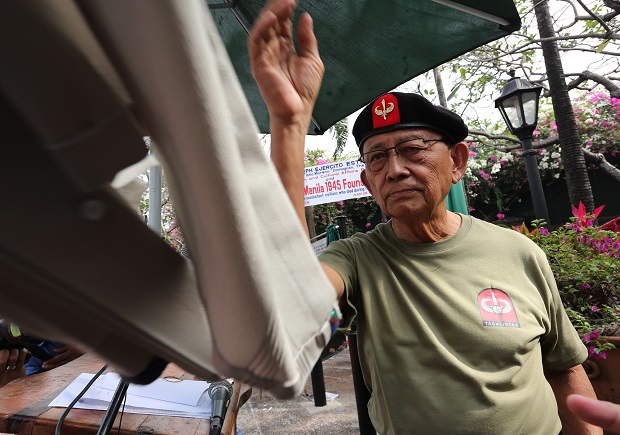
MANILA, Philippines–What’s so difficult about saying you’re sorry, former President Fidel Ramos asked on Wednesday.
In Ramos’ book, President Aquino can learn from his predecessor, Gloria Macapagal-Arroyo, in the humility department.
Ramos, who just turned 87, said in a news conference Aquino should
take responsibility for the slaughter of 44 Special Action Force (SAF)
commandos in Mamasapano on Jan. 25 and apologize.
“What’s so difficult about that? A previous President said ‘I am
sorry,’ and so that removed a lot of pressure on that person although
eventually other things came up to cause her temporary detention in a
hospital for alleged crimes,” Ramos said, referring to Arroyo, now
Pampanga representative, who is under hospital arrest on plunder
charges.
Ramos said that Aquino could still redeem himself, pointing out,
“Saying ‘I’m sorry’ humbly and sincerely would probably do 90 percent of
the job.”
He explained that an apology from the President at this point would
not work 100 percent because of the “hurt” that has gone deeper over the
Mamasapano incident which started when Aquino failed to show up at
Villamor Air Base on Jan. 29 to wait for the arrival of caskets bearing
the slain commandos.
“The recalcitrance of Malacañang, I’m not talking only about the
President but also his spokespersons and handlers, has led to this
situation in the Philippines today. There is so much divisiveness now… I
am sure the national interest does not include being divided among
ourselves in this manner now. Matindi ito (This is serious),” Ramos
said.
Malacañang said no apology from Aquino on the Mamasapano debacle was forthcoming.
“We had discussions with him (Tuesday), but none touching on the call
for him to issue an apology over it,” said Abigail Valte, presidential
deputy spokesperson. “None so far.”
Valte said that in his address to the nation Feb. 6, the President
already had taken responsibility for the botched operation in
Maguindanao province when he accepted the resignation of suspended
Philippine National Police Director General Alan Purisima.
The President is the Commander in Chief of the Philippine National
Police, Ramos said, based on an executive order he himself signed as
then Chief Executive in 1995 to clarify “dark areas” on the doctrine of
chain of command pertaining to the police.
“The operative principle in governance, whether in a civil or
informal government, the military, police and also the uniformed forces,
the coast guard, militia and even private security agencies, there is a
chain of command that operates under the principle of command
responsibility,” he pointed out.
“We have been respecting the doctrine of command responsibility ever
since we were established as a government,” he said, pointing out that
government and police officials faced criminal prosecution for failure
to take preventive or corrective action on the commission of a crime by a
subordinate.
“In the case of the President, however, the matter can be imposed in a
higher administrative punishment later on. But for a sitting President
or incumbent, at that point in time, the only recourse is through
impeachment,” Ramos said.
He emphasized that the President’s job was to take care of the
national interest, the defense of the national territory’s sovereignty
and integrity and maintaining a position of respect, dignity and even
admiration among the family of nations.
He said that as President, he faced three Senate blue ribbon
investigations on alleged corruption in the Centennial Expo in Clark,
the funding for the rehabilitation of Smokey Mountain and the purchase
and sale of the country’s power plants. He was cleared of any
irregularities in the deals.
“This is the future every President must confront manfully and
truthfully. This is part of the job when you enter into the electoral
contest for the highest position of the land. You better expect that the
highest kinds of alleged crimes will be hit on you. That’s the way it
goes in this democracy of ours,” he said.–With a report from Nikko Dizon
| Inquirer News
Showing posts with label Politics. Show all posts
Showing posts with label Politics. Show all posts
Mar 19, 2015

Singapore tries to imagine a future without Lee Kuan Yew
SINGAPORE — When his ruling party won all but
two of the 84 seats up for grabs in parliamentary elections nine years
ago, Lee Kuan Yew, the founder of modern Singapore, declared: “Please do
not assume that you can change governments. Young people don’t
understand this.”
Fast forward to today, and things are changing in this high-tech city-state.
For one, people here are facing the prospect of a Singapore without Lee.
Now
91, the elder statesman was hospitalized with pneumonia at the
beginning of February and placed on a ventilator. The office of Prime
Minister Lee Hsien Loong — Lee’s eldest son — said Tuesday that his
condition had worsened due to an infection. On Wednesday, it said he had
deteriorated further and was critically ill in the intensive care unit.
Although
Lee has been ill before and rebounded, there is a sense here that this
time is more serious and that Singapore might, on the 50th anniversary
of its independence, be marking another historic moment.

becoming the Southeast Asian island’s first prime minister in 1959, Lee
oversaw its independence from Britain and Malaysia, then used a
far-sighted economic vision and an iron fist to transform Singapore from
a third-world colonial trading post into a glittering, multicultural
commercial hub.
This was done by encouraging business with easy
regulations and low taxes, and by using big government to look after
citizens. But progress was made at the expense of civil liberties, with
the media stifled — often through libel suits — and political dissent
barely tolerated.
Although his three-decade reign as prime
minister ended in 1990, he held advisory positions until four years ago
and has continued to exert his influence both through his son, who
became prime minister in 2004, and his People’s Action Party, which has a
stranglehold on the parliament.
“Just like all the great men who
built Southeast Asia in the postcolonial period, Lee Kuan Yew is a
presence for as long as he breathes,” said Ernest Z. Bower, an expert on Southeast Asia at the Center for Strategic and International Studies.
“Singapore
is now looking for change and evolution,” Bower said, “but they're not
sure. I think there's a little bit of fear and anxiety about all of
this.”
Even Lee Hsien Loong, the current prime minister, acknowledges that Singapore is at an “inflection point.”
While
older people here remember what life was like before the transformation
and have been willing to put up with the restrictions, people in their
20s and 30s increasingly are not.
“Previous generations had all
their necessities taken care of and were happy with [Lee] when he was
prime minister,” said Abdul Kadir bin Ibrahim, a Singaporean in his 50s
who runs a clothing store in the Arab Street district.
The
younger generation is more outspoken, he said. “Most of them are highly
educated, and they come from families where they have not had to
struggle to survive, and they have been more exposed to the outside
world, so it’s inevitable that there will be some change.”
Carlton
Tan, a local journalist, is one of those younger Singaporeans who has
mixed feelings about the anticipated demise of a man he called a
“likeable despot.”
“We simultaneously love and hate, respect and despise, cherish and abhor, the man,” he wrote in a recent column.
“We are thankful for our decades of economic progress, but we wonder
whether it was really necessary to sacrifice our freedoms. We are
grateful for the stability and security, but we wonder whether we can
maintain it without a strong civil society.”
Now, Singaporeans
can honor their founding father by “asking tough questions, making hard
choices, and imagining a different Singapore,” Tan said.
An opportunity to vote for a different Singapore is approaching.
During
the last general elections in 2011, the ruling party lost six of 87
parliamentary seats — a result that was considered an omen of change.
The opposition is expected to win more seats in elections to be held
next year.
Political changes are being accelerated by economic
ones as income disparities have widened. The number of billionaires is
rising, while a quarter of the population lives below the poverty line
and increasingly struggles to afford the basics.
Immigration is
also a pressing issue. Foreigners comprise a third of Singapore’s
population, and while many are working in construction and household
jobs that educated Singaporeans do not want to do, there is a growing
sense that they are also taking more coveted jobs from Singaporeans.
The
government — perhaps with one eye on the similarly glittering,
commercial island of Hong Kong, where calls for greater democratic
representation resulted in protests last year — has seemed more willing
to create some space for civil society.
Gillian Koh, a senior
research fellow at the Institute of Policy Studies of the National
University of Singapore, notes that ground-up activism has resulted in
tangible changes in recent years, such as the reform of the death
penalty, the strengthening of harassment laws, and a major recalibration
in social support policies.
The government’s responsiveness to
concerns raised by civil society and citizens’ activism may mitigate the
appeal of opposition politics, she said.
“The government’s
efforts to engage civil society have resulted in policy changes and a
more participatory governance equation. Even if there is political
diversity, this could temper what traction opposition politicians might
have,” Koh said.
But the departure of Lee could also have
implications for the United States. Although Singapore is not a treaty
ally, Washington has for decades relied on Lee to interpret events in
Asia for it.
“Every president since Nixon has valued his counsel
as a person who has been the world’s premier China watcher,” said
Graham Allison, a professor at Harvard’s Kennedy School of Government
and the co-author of a book on Lee, whom he calls “the grand master.”
“He’s
a person who can understand China and its leadership and its choices
from the inside,” Allison said. “There’s no person who could play this
role, helping Chinese leaders really understand something about the U.S.
and helping American leaders really understand something about China.”
But
some analysts note that the Obama administration has lessened
Washington’s reliance on Singapore. While Lee used to visit the White
House almost every year, his son has been there only once during
President Obama’s tenure.
This is partly due to better relationships with other Asian countries — and better intelligence about China.
But Allison said it would be foolish for Washington to distance itself
from Singapore as the “Thucydidean challenge” of competing with a rising
China becomes greater. (Thucydides ,the ancient Greek historian and
political realist, believed that relations between nations were based on
power, not justice.)
“I would say that we need someone like Lee
Kuan Yew more than ever because, coming from a small, very successful
city-state, he can look to either a Chinese or an American like an
independent, wise counsel,” Allison said.
By Anna Fifield
- The Washington Post
Mar 18, 2015
14 senators sign report making Aquino responsible for Mamasapano
MANILA,
Philippines — Fourteen senators have signed a Senate draft report
that found President Benigno Aquino III responsible for the January
25 Mamasapano operation, Senator Grace Poe said on Wednesday.
Poe drafted the report as head of the Senate committee on public
order that investigated the incident along with the committees on peace,
unification, reconciliation, and finance.
 Sen.
Sen.
Grace Poe, chair of the Senate committee on public order, shares with
the media a summary of the findings of the Senate probe into the
Mamasapano tragedy. JOAN BONDOC / INQUIRERThe 14 senators who have signed the report are
Wednesday noon while Senator Joseph Victor “JV” Ejercito will personally
sign on Thursday when he returns from the United States.
The 14 signatories, she said, were already the majority number needed
to transmit the draft report to the plenary for either adoption or
rejection.
“Yes, majority,” Poe told reporters in a text message.
“But I will file first on Thursday and wait for additional
attachments from senators whom I requested to submit their additional
positions in writing, if they have any. I will present this in May,” she
added.
| Inquirer News
Philippines — Fourteen senators have signed a Senate draft report
that found President Benigno Aquino III responsible for the January
25 Mamasapano operation, Senator Grace Poe said on Wednesday.
Poe drafted the report as head of the Senate committee on public
order that investigated the incident along with the committees on peace,
unification, reconciliation, and finance.
Grace Poe, chair of the Senate committee on public order, shares with
the media a summary of the findings of the Senate probe into the
Mamasapano tragedy. JOAN BONDOC / INQUIRER
- Senator Grace Poe
- Senator Francis Escudero
- Senator Vicente “Tito” Sotto III
- Senator Serge Osmena
- Senator Aqulino Pimentel III
- Senator Ferdinand “Bongbong” Marcos Jr
- Senator Alan Cayetano
- Senator Pia Cayetano
- Senator Nancy Binay
- Senator Ralph Recto
- Senator Miriam Defensor-Santiago (via electronic signature)
- Senator Gringo Honasan
- Detained Senator Jose “Jinggoy” Estrada
- Detained Senator Ramon “Bong” Revilla Jr.
Wednesday noon while Senator Joseph Victor “JV” Ejercito will personally
sign on Thursday when he returns from the United States.
The 14 signatories, she said, were already the majority number needed
to transmit the draft report to the plenary for either adoption or
rejection.
“Yes, majority,” Poe told reporters in a text message.
“But I will file first on Thursday and wait for additional
attachments from senators whom I requested to submit their additional
positions in writing, if they have any. I will present this in May,” she
added.
| Inquirer News
Apr 11, 2013
Enrile story goes viral: ‘The audacity,’ that’s our money!
“Write to the senators. Tweet them. Ask them if they returned the Enrile bonus. DEMAND ANSWERS. MAKE THEM ACCOUNTABLE. PERA NATIN YUN!” exhorted user @yogon. By Lawrence de GuzmanPhilippine Daily Inquirer
Senate President Juan Ponce-Enrile
Senate President Juan Ponce Enrile’s Christmas cash gift of almost P30 million to his fellow senators rubbed Filipino netizens the wrong way, with some critics describing it as “suspicious” and “unethical.” The report on Enrile’s cash gift, which the Philippine Daily Inquirer broke Wednesday, immediately made the rounds of social networking sites as flustered readers shared it on their Twitter and Facebook accounts. The story easily became the most read article on INQUIRER.net, the broadsheet’s official website, with hundreds of users swarming to the comments section. On Facebook, the article had been recommended by users over 6,000 times by Wednesday evening. “Enrile has no power whatsoever to disburse public money indiscriminately!!! Regardless of the type of funds these are allocated to, these still belong to the government of the Filipinos and therefore cannot be spent arbitrarily,” user Bansot commented on the Inquirer website. “While the rest of the Filipinos are working hard, these senators are living luxurious lives,” user Jeff Castillo commented on the story. “What a way to end his political career, being true to form as a self-serving and corrupt politician,” user kulittwit chimed in. The Inquirer reported that Enrile gave 18 senators P1.6 million each, while four senators got P250,000 each—Antonio “Sonny” Trillanes IV, Miriam Defensor-Santiago, Alan Peter and sister Pia Cayetano who were known to have differences with Enrile. The cash gift, billed as “additional MOOE” or maintenance and other operating expenses, allegedly came from the funds allotted for the Senate post vacated by President Aquino when he won the presidential election in 2010. A senator described the gift as “unconscionable and unconstitutional” and that it could be interpreted as a bribe to prevent his ouster as Senate President, an observation shared by many in cyberspace. In response to these allegations, Enrile took to his official Twitter account, @SPJPE, and tweeted, “Those Senators who think that I am bribing anyone with additional budgets in order to keep my post as Senate President must have a very low opinion about their own colleagues.” “I was elected as Senate President twice and I can look at anyone straight in the eye in saying that I did not buy this position. Not one single centavo of the people’s money was spent just to enable me to cling to this office,” he continued. He issued the same statement to Senate reporters. Still, not many were pleased with Enrile’s distribution of the Senate funds as Christmas gift to his colleagues. “I find Enrile’s generosity suspicious and unethical,” tweeted user @i Jakebustos. ‘The audacity’ “This is a matter that @noynoyaquino should really look into … it stinks of unethical practices using public funds,” said user @kazekhan. “The audacity! Can only come from someone who thinks he’s above the law,” user @retromaldita tweeted. “Imagine if you actually gave that back to the people,” tweeted user @rdacalos. “Those senators had the conscience to accept those gifts amid the catastrophe in Mindanao?” tweeted user @beareyno. “What would folks from Davao feel? Common practice, but was it ethical?” asked user @LiberatingJepoy. This is where taxes go “Kaya lang galante mga trapong yan kasi d nila pera tinatapon nila (They are generous because it’s not their money),” user @IvesNisceII tweeted. “KAPAL! This is where our taxes go!,” said user @jed_pv.
Tags: Christmas , Facebook , Government , INQUIRER.net , Internet , Juan Ponce Enrile , politics , Senate , Social Media , State Budget , technology , Twitter
Jan 30, 2013
Drilon slams UNA for trying to make Aquino ‘lame duck’ president
MANILA, Philippines – Senator Franklin Drilon has accused the United Nationalist Alliance (UNA) of allegedly trying to make President Benigno Aquino III a “lame duck” ever since he assumed office in 2010.
And the President himself, Drilon said, was “conscious” of that effort by UNA, headed by Vice President Jejomar Binay and former President Joseph Estrada.
“I am sure Toby won’t admit it. But the objective, in any not only in UNA, in general on opposition, for the last three years of this administration, (they) are trying to make this administration a lame duck,” he said in an interview over ABS-CBN News Channel (ANC) Tuesday night.
Toby is Navotas Representative Tobias Tiangco, secretary –general of UNA, who was also being interviewed on the same network. Drilon, meanwhile is the campaign manager of the Liberal Party-led coalition ticket.
“There is nothing wrong with that, by the way, because you compete for political power and therefore, part of that, you try to make the incumbent sitting President a lame duck. We are conscious of that. The President is conscious of that. And we draw the line. We will not be lame duck. We will have the majority of the people with us because we still have reforms to do,” Drilon said.
“Yes. Let us call a spade a spade. Maybe not in your show they will never admit that they are trying to make the President a lame duck. But in their internal meetings, natural iyon. Huwag na tayong maglokohan. Let’s call a spade a spade,” he said.
“But that’s a challenge for us. We will show that for the next three years, we will do things correctly; we will do things in a manner that a decent right-thinking will do regardless of a politics,” he added.
Tiangco, responding to Drilon’s statements, said he would not concede that they would like to make the President a lame duck.
“I agreed that we are competing with the LP, but we equally support the good programs of the administration. Yung LP lang ang katunggali namin sa pulitika,” Tiangco said.
“And the President happens to be our chairman,” Drilon said.
“But he also happens to be the President of the Philippines,” said the UNA spokesman.
Drilon then reiterated his call for UNA to draw the lines and admit that they are the opposition.
“I have always told Toby: let’s define the lines. We are the administration, you are the opposition. There is nothing wrong with that. In democracy, opposition is necessary,” said the senator.

Subscribe to:
Posts (Atom)
Popular Posts
-
via washingtonpost.com It has been awhile since I spent some quality time in Android. While I was away, it appears we have both chang...
-
Bong Joon-ho (The Host) is finished off his next film, Snowpiercer . Based on the French graphic novel Le Transperceneig...
-
Galaxy S launches seem to carry a curse for SK Telecom. Last year the Korea Communications Commission (KCC) imposed a ban on SK preventing s...
-
i The graffiti on an Egyptian carving at the 3,500-year-old Luxor Temple reads: "Ding Jinhao was here." The pa...
-
Were you among those who jumped for joy when Windows Explorer got its new moniker? Good news, nomenclature fans, for Redmond has de...
-
Photographs by Ty Wright for BuzzFeed News, Isaac Hinds “Bodybuilder” is not the first word that comes to mind when you see Ashle...
-
“Fifty Shades of Grey” easily dominated the competition this Valentine’s Day weekend. The number of weeks open for eac...
-
Tyson Beckford Treats Mariah Carey to the Lap Dance of a Lifetime Like us on Facebook Mariah Carey is working and playing hard in La...
-
If the recent series of Captain America: Civil War casting announcements and leaked promotional art didn’t make it clear, Marvel’s ne...
-
Sam Smith/Instagram A lot can happen in two weeks — ju...


