In the wake of Typhoon Haiyan slamming into the Philippines, relief organizations are calling on Americans to donate funds to their efforts. Want to donate to a group not listed below?CharityNavigator.org rates organizations based on their financial health, accountability and transparency.
Dec 2, 2013
How you can help Typhoon Haiyan survivors
In the wake of Typhoon Haiyan slamming into the Philippines, relief organizations are calling on Americans to donate funds to their efforts. Want to donate to a group not listed below?CharityNavigator.org rates organizations based on their financial health, accountability and transparency.
Nov 12, 2013
'Nothing left to loot' in devastated Tacloban
Struggle for Survival in Philippine City Shattered by Typhoon
By KEITH BRADSHER
Published: November 11, 2013 255 Comments
Readers’ Comments
"The scenes reveal the government's incompetence. As always the impoverished have to bear the brunt of the havoc. "J. Von Hettlingen, Switzerland
Nov 11, 2013
1,200 feared dead in typhoon-devastated Philippines
A day after Supertyphoon “Yolanda” (international name: Haiyan) whipped across the central Philippines with maximum sustained winds of around 315 kilometers an hour, a picture emerged of entire communities having been flattened.
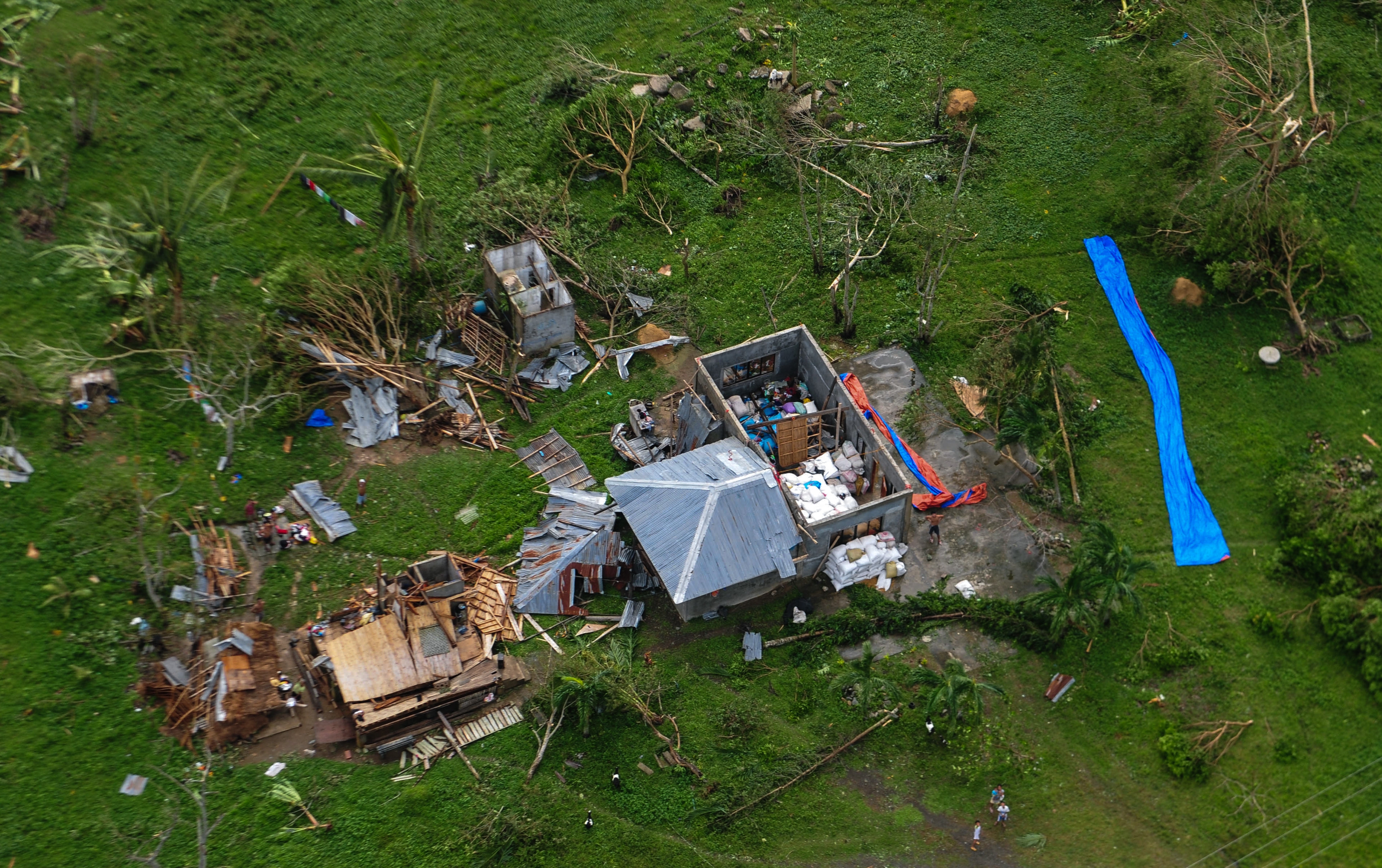
Authorities said that, aside from the ferocious winds, storm surges of up to 10 feet high that swept into coastal towns and deep inland were responsible for destroying countless homes.
“Imagine a strip one kilometre deep inland from the shore, and all the shanties, everything, destroyed,” Interior Secretary Mar Roxas said after visiting coastal towns in Leyte, one of the worst-hit provinces in the east of the archipelago.
“They were just like matchsticks flung inland. All the houses were destroyed.”
The official government death toll on Saturday night was 138.
But with rescue workers yet to reach or communicate with many ravaged communities across a 600-kilometer stretch of islands, authorities said they were unable to give a proper assessment of how many people had been killed.
Philippine Red Cross secretary general Gwendolyn Pang said her organization estimated 1,200 people had died, while a UN official who visited Leyte described apocalyptic scenes.
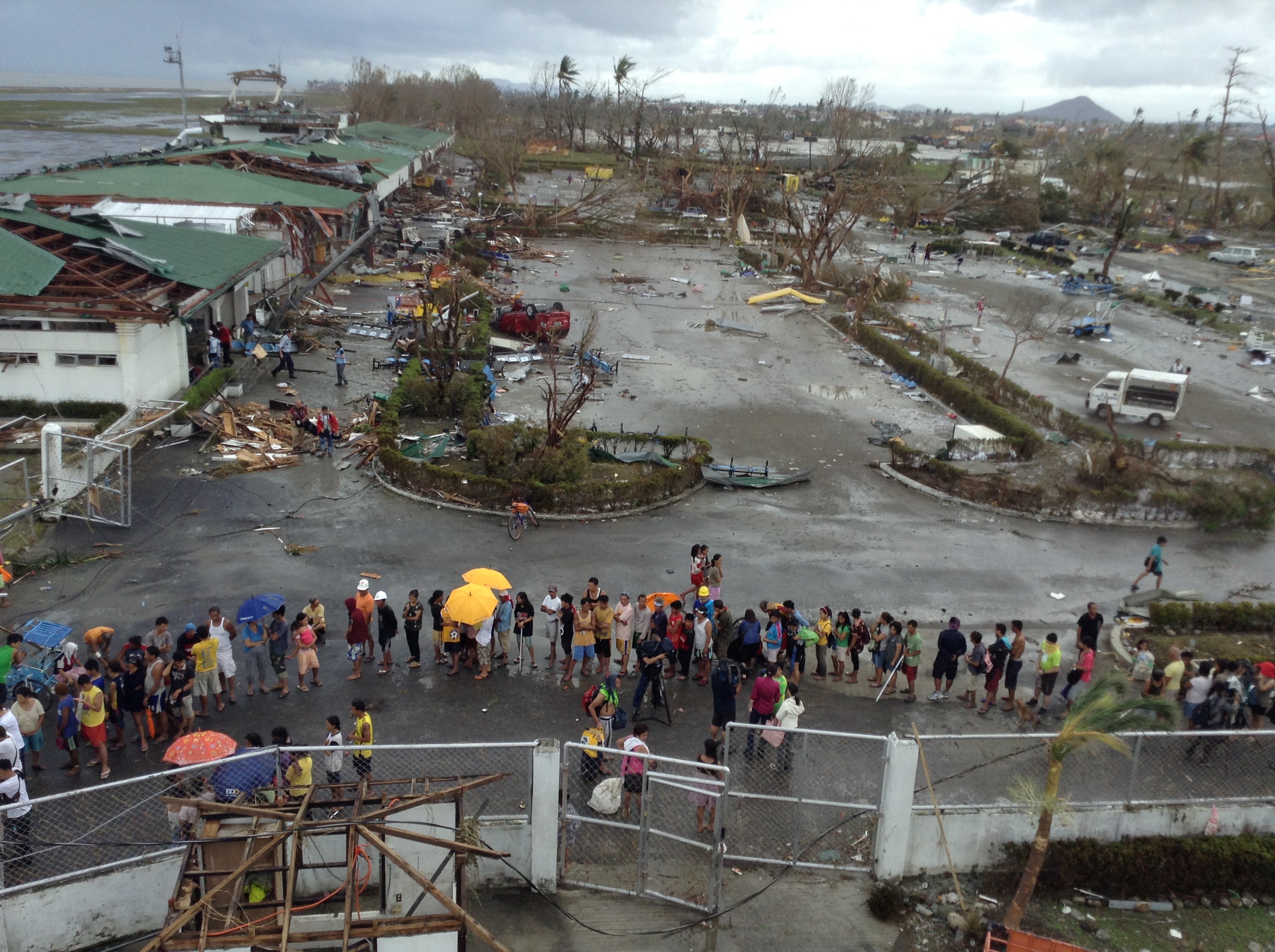
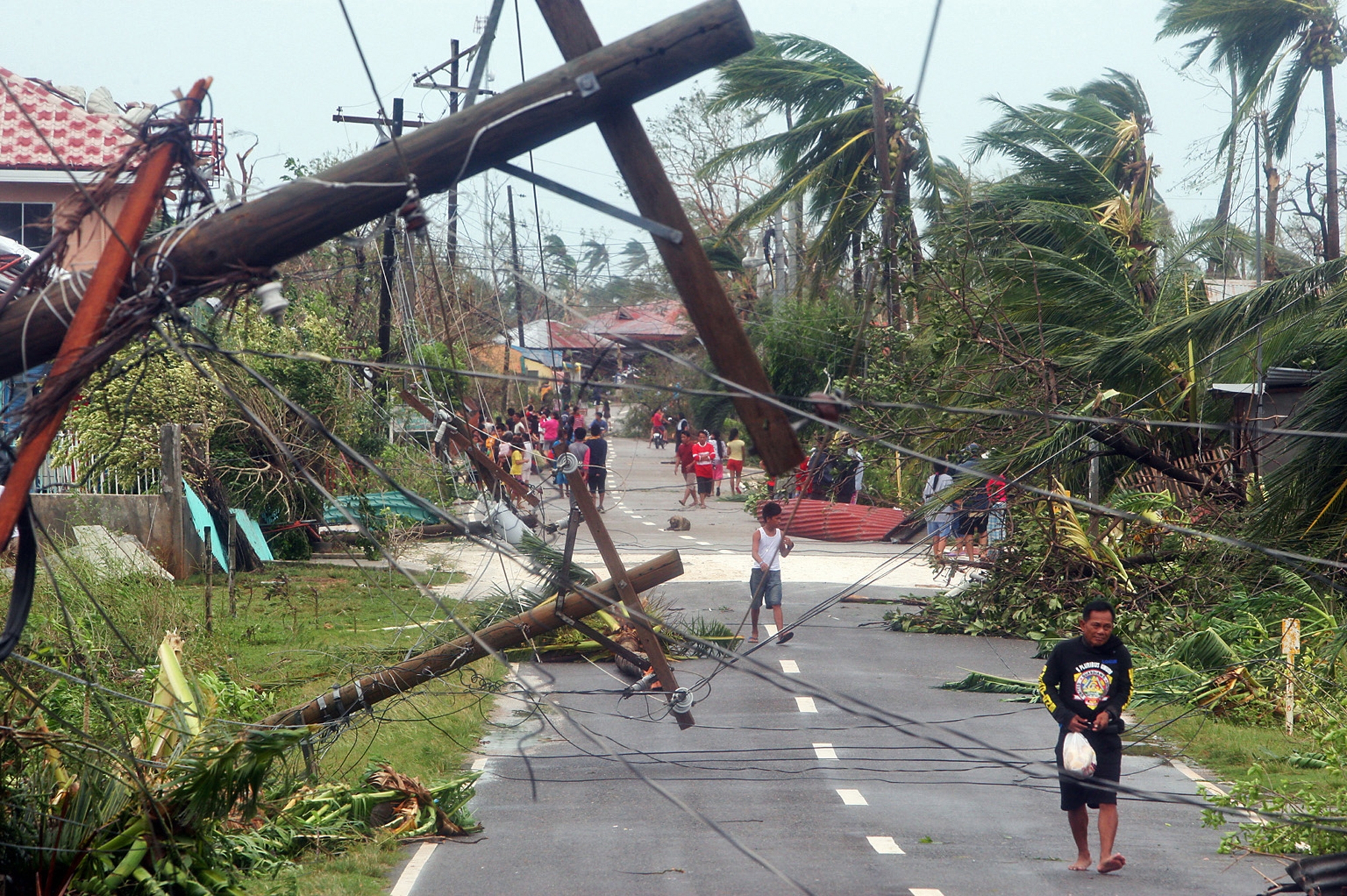
“This is destruction on a massive scale. There are cars thrown like tumbleweed and the streets are strewn with debris,” said Sebastian Rhodes Stampa, the head of a UN disaster assessment coordination team.
“The last time I saw something of this scale was in the aftermath of the Indian Ocean tsunami,” he said, referring to the 2004 disaster that claimed about 220,000 lives.
Stampa made his comments after arriving in Tacloban City, the destroyed capital of Leyte with a population of about 220,000 people.
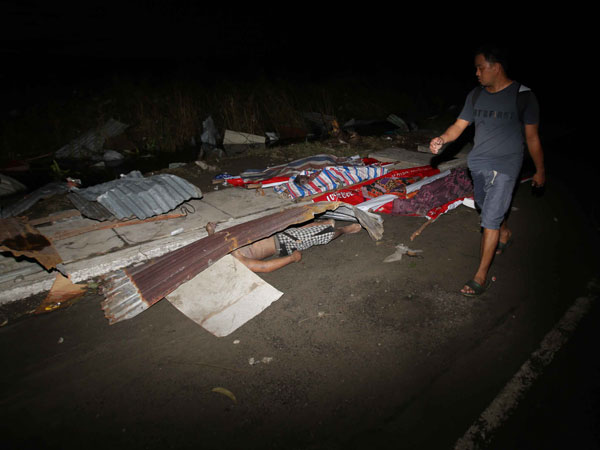
More than 100 bodies were littered in and around Tacloban’s airport, according to the facility’s manager.
One resident, Dominador Gullena, cried as he recounted to AFP his escape but the loss of his neighbours.
“My family evacuated the house. I thought our neighbours also did the same, but they didn’t,” Gullena said.
Eight bodies had been laid to rest inside Tacloban airport’s chapel, which had also been badly damaged, according to an AFP photographer.
One woman knelt on the flood-soaked floor of the church while holding the hand of a dead boy, who had been placed on a wooden pew.
Energy Secretary Jericho Petilla reached the fishing town of Palo, about 10 kilometres from Tacloban, by helicopter and said he believed “hundreds” of people had died just in that area.
Pope Francis tweeted his support for the typhoon victims: “I ask all of you to join me in prayer for the victims of Typhoon Haiyan/Yolanda especially those in the beloved islands of the Philippines.”
Race to reach decimated communities
Meanwhile, the military, government relief workers and non-government organisations battled to reach communities and deliver desperately needed supplies.
Fifteen thousand soldiers were in the disaster zones and helping in the rescue effort, military spokesman Lieutenant-Colonel Ramon Zagala told AFP.
Zagala said helicopters were flying rescuers into priority areas, while infantry units deployed across the affected areas were also proceeding on foot or in military trucks.
Haiyan’s wind strength, which remained close to 300 kilometres an hour throughout Friday, made it the strongest typhoon in the world this year and one of the most intense ever recorded.
It exited into the South China Sea on Saturday and tracked towards Vietnam, where more than 200,000 people crammed into storm shelters.
Philippine authorities had expressed confidence on Friday that only a few people had been killed, citing two days of intense preparation efforts led by President Benigno Aquino.
Nearly 800,000 people in danger zones had been moved to evacuation centres, while thousands of boats across the archipelago were ordered to remain secured at ports. Hundreds of flights were also cancelled.
Aquino said on Saturday night it appeared some communities had not heeded the warnings.
An average of 20 major storms or typhoons, many of them deadly, batter the Philippines each year as they emerge from the Pacific Ocean.
The Philippines suffered the world’s strongest storm of 2012, when Typhoon Bopha left about 2,000 people dead or missing on the southern island of Mindanao.
Haiyan is expected to make landfall in central Vietnam early Sunday, with millions of people thought to be in its path.
Authorities have begun mass evacuations in at least four central coastal provinces, Vietnam’s state-run VNExpress news site said, as the country was put on high alert.
Originally posted at 9:39 p.m. | November 9, 2013
Obama ‘deeply saddened’ by Philippines devastation
Obama said the United States is providing “significant” humanitarian assistance and is prepared to further assist relief and recovery efforts.
“Yolanda” struck the eastern seaboard of the Philippines on Friday and quickly barreled across its central islands, packing winds that gusted up to 170 miles (274 kilometers) per hour.
The death toll has climbed into the thousands, and about 4 million people were affected by the storm.
Obama praised the Philippine people for their “incredible resiliency.”
‘Yolanda’ slams PH; high death toll feared
At least 138 people were confirmed dead in the aftermath of Typhoon Haiyan (local name “Yolanda”). But Philippine Red Cross Secretary General Gwen Pang said that agency field staff in the region estimated the toll was about 1,000. Pang, however, emphasized that it was “just an estimate.”
The typhoon slammed into six central Philippine islands on Friday, wiping away buildings and leveling seaside homes. At least 118 of the confirmed deaths were on hardest-hit Leyte Island, where Tacloban is located, said national disaster agency spokesman Maj. Reynaldo Balido.
But after arriving in Tacloban on Saturday, Interior Secretary Mar Roxas said it was too early to know how many people had died in the storm, which was heading toward Vietnam after moving away from the Philippines.
“The rescue operation is ongoing. We expect a very high number of fatalities as well as injured,” Roxas said. “All systems, all vestiges of modern living — communications, power, water — all are down. Media is down, so there is no way to communicate with the people in a mass sort of way.”
President Benigno Aquino III said the casualties “will be substantially more,” but gave no figure or estimate. He said the government’s priority was to restore power and communications in isolated areas to allow for the delivery of relief and medical assistance to victims.
The airport in Tacloban, a city of 200,000 located about 580 kilometers (360 miles) southeast of Manila, looked like a muddy wasteland of debris Saturday, with crumpled tin roofs and upturned cars. The airport tower’s glass windows were shattered, and air force helicopters were busy flying in and out at the start of relief operations.
“The devastation is, I don’t have the words for it,” Roxas said. “It’s really horrific. It’s a great human tragedy.”
Defense Secretary Voltaire Gazmin said Aquino was “speechless” when he told him of the devastation the typhoon had wrought in Tacloban.
“I told him all systems are down,” Gazmin said. “There is no power, no water, nothing. People are desperate. They’re looting.”
U.S. Marine Col. Mike Wylie surveyed the damage in Tacloban prior to possible American assistance. “The storm surge came in fairly high and there is significant structural damage and trees blown over,” said Wylie, who is a member of the U.S.-Philippines Military Assistance Group based in Manila.
U.S. Secretary of State John Kerry said in a statement that America “stands ready to help.”
Tacloban is near the Red Beach on Leyte Island where U.S. Gen. Douglas MacArthur waded ashore on October 20, 1944, fulfilling his famous pledge, “I shall return,” made in March 1942 after President Franklin D. Roosevelt ordered him to relocate to Australia as Japanese forces pushed back U.S. and Filipino defenders.
Tacloban was the first city to be liberated by U.S. and Filipino forces and served as the Philippines’ temporary capital for several months. It is also the home town of former Filipino first lady Imelda Marcos, whose nephew, Alfred Romualdez, is the city’s mayor.
The president of the European Commission, Jose Manuel Barroso, said in a message to Aquino that the EC had sent a team to assist the Philippine authorities and that “we stand ready to contribute with urgent relief and assistance if so required in this hour of need.”
Weather officials said Haiyan had sustained winds of 235 kilometers per hour (147 miles per hour), with gusts of 275 kph (170 mph), when it made landfall. By those measurements, Haiyan would be comparable to a strong Category 4 hurricane in the U.S., and nearly in the top category, a 5. Hurricanes, cyclones and typhoons are the same, but have different names in different parts of the world.
One Tacloban resident said he and others took refuge inside a parked Jeep to protect themselves from the storm, but the vehicle was swept away by a surging wall of water.
“The water was as high as a coconut tree,” said 44-year-old Sandy Torotoro, a bicycle taxi driver who lives near the airport with his wife and 8-year-old daughter. “I got out of the Jeep and I was swept away by the rampaging water with logs, trees and our house, which was ripped off from its mooring.”
“When we were being swept by the water, many people were floating and raising their hands and yelling for help. But what can we do? We also needed to be helped,” Torotoro said.
In Torotoro’s village, bodies could be seen lying along the muddy main road, as residents who had lost their homes huddled, holding on to the few things they had managed to save. The road was lined with trees that had fallen to the ground.
Vice Mayor Jim Pe of Coron town on Busuanga, the last island battered by the typhoon before it blew away to the South China Sea, said most of the houses and buildings there had been destroyed or damaged. Five people drowned in the storm surge and three others were missing, he said by phone.
“It was like a 747 flying just above my roof,” he said, describing the sound of the winds. He said his family and some of his neighbors whose houses were destroyed took shelter in his basement.
Philippine broadcaster ABS-CBN showed fierce winds whipping buildings and vehicles as storm surges swamped Tacloban with debris-laden floodwaters.
In the aftermath of the typhoon, people were seen weeping while retrieving bodies of loved ones inside buildings and on a street that was littered with fallen trees, roofing material and other building parts torn off in the storm’s fury. All that was left of one large building whose walls were smashed in were the skeletal remains of its rafters.
Many packed evacuation centers collapsed in Tacloban as the typhoon raged, a police official said. He said he saw a popular mall being looted Saturday by residents who carted away anything they can lay their hands on, including a flat-screen TV, a small refrigerator, food items, clothes and even a Christmas tree. Smaller shops with guards brandishing their pistols were spared, said the official, who spoke on condition of anonymity because he was not authorized to talk to reporters.
ABS-CBN television anchor Ted Failon, who was able to report only briefly Friday from Tacloban, said the storm surge was “like the tsunami in Japan.”
“The sea engulfed Tacloban,” he said, explaining that a major part of the city is surrounded on three sides by the waters between Leyte and Samar islands.
The Philippine television station GMA reported that its news team saw 11 bodies, including that of a child, washed ashore Friday and 20 more bodies at a pier in Tacloban hours after the typhoon ripped through the coastal city.
At least 20 more bodies were taken to a church in nearby Palo town that was used as an evacuation center but had to be abandoned when its roofs were blown away, the TV network reported. TV images showed howling winds peeling off tin roof sheets during heavy rain.
Relief workers said they were struggling to find ways to deliver food and other supplies, with roads blocked by landslides and fallen trees.
Tim Ticar, a local tourism officer, said 6,000 foreign and local tourists were stranded on the popular resort island of Boracay, one of the tourist spots in the typhoon’s path.
U.N. Secretary-General Ban Ki-moon offered his condolences and said U.N. humanitarian agencies were working closely with the Philippine government to respond rapidly with emergency assistance, according to a statement released by the U.N. spokesperson’s office.
UNICEF estimated that about 1.7 million children are living in areas impacted by the typhoon, according to the agency’s representative in the Philippines Tomoo Hozumi. UNICEF’s supply division in Copenhagen was loading 60 metric tonnes of relief supplies for an emergency airlift expected to arrive in the Philippines on Tuesday.
The storm’s sustained winds weakened Saturday to 163 kph (101 mph) with stronger gusts as it blew farther away from the Philippines toward Vietnam.
Haiyan was forecast to hit central Vietnam’s coast on Sunday afternoon, making its way to the northern part of the country before likely weakening to a tropical storm.
Vietnamese authorities in four central provinces were evacuating more than 500,000 people from high-risk areas to government buildings, schools and other concrete homes able to withstand strong winds.
“The evacuation is being conducted with urgency,” disaster official Nguyen Thi Yen Linh said from central Danang City, where some 76,000 were being moved to safety.
Hundreds of thousands of others were being taken to shelters in the provinces of Quang Ngai, Quang Nam and Thua Thien Hue. Schools were closed and two deputy prime ministers were sent to the region to direct the preparations.
Associated Press
‘Yolanda’ slams PH; high death toll feared | Inquirer Global Nation
Apr 11, 2013
General Gets Girlie Makeover for Marcos Birthday
Imelda Marcos returned to the Philippines after her husband’s death and the family slowly regained some political power. Imelda is a congresswoman and her son, Ferdinand Jr., is a senator eyeing a presidential run in 2016. Agence France-Presse
Ferdinand Marcos. AFP FILE PHOTO
Then Philippine dictator Ferdinand Marcos forced his military chiefs to parade as women during a tasteless, sycophantic birthday party planned by his unstable wife, according to US diplomatic cables. The US ambassador to the Philippines in the mid-1970s, William Sullivan, wrote a series of blistering criticisms of Ferdinand and Imelda Marcos in secret cables that have since been declassified and published by WikiLeaks. In one of the reports, dated Sept. 12, 1973, Sullivan recounted a “two-day blast” of a party for Ferdinand Marcos that he said was at odds with state-controlled media reports that he “spent a quiet birthday at his desk.” “In general, every aspect of the occasion was too much, too long, and in questionable taste,” Sullivan wrote in the report to Washington. Sullivan wrote that one of the lowest points was when military chiefs were required, under instructions from Imelda Marcos, to perform in a presidential Palace floor show “in garish female attire.” “This whole affair was a saccharine suffusion of sycophancy,” he wrote, according to the cables published on the website of the antisecrecy organization this week. Ferdinand Marcos ruled the Philippines for nearly 20 years until an Army-backed “People Power” uprising involving millions of people forced him to flee into US exile in 1986. He died in Hawaii three years later. While Sullivan appeared in the cables not to personally care much for either of the Marcoses, the United States supported the dictatorship until the final moments of the revolution. Royal weddingSullivan wrote repeatedly of what he saw as the personality flaws of Imelda Marcos, who cultivated immense power during her husband’s rule and famously lived a lavish lifestyle while most Filipinos endured brutal poverty. In one cable, he warned British diplomats that Imelda would not be concerned about protocol in trying to get herself invited to Princess Anne’s wedding. “First lady has reputation for royal manner of lifestyle in Philippines and would not be above lobbying for invitation to British royal wedding,” he wrote. ‘Perspective a bit awry’ In 1974 cables ahead of a visit by Imelda Marcos to the United States, Sullivan warned his head office that communist Chinese leaders had done a “very effective snow job” that had colored her outlook on the all things American. Sullivan said she was particularly concerned that her daughter Imee was surrounded by “faggots” while studying at Princeton University. “Given all this background, Imelda is in a slightly touchy state and a small offense or an untoward incident could spell lasting damage. She has not lost her sense of humor, but perspective is more than a bit awry,” he warned.
Tags: Diplomacy , Ferdinand Marcos , Imelda Marcos , Internet , Military , Philippines , US , WikiLeaks
Mar 4, 2013
Philippines’ elite swallow country’s new wealth
MANILA – Optimism is soaring that the Philippines is finally becoming an Asian tiger economy, but critics caution a tiny elite that has long dominated is amassing most of the new wealth while the poor miss out.
President Benigno Aquino has overseen some of the highest growth rates in the region since he took office in 2010, while the stock market has hovered in record territory, credit ratings have improved and debt ratios have dropped.
“The Philippines is no longer the sick man of East Asia, but the rising tiger,” World Bank country director Motoo Konishi told a forum attended by many of Aquino’s economic planning chiefs recently.
However economists say that, despite genuine efforts from Aquino’s team to create inclusive growth, little progress has been made in changing a structure that for decades has allowed one of Asia’s worst rich-poor divides to develop.
“I think it’s obvious to everyone that something is structurally wrong. The oligarchy has too much control of the country’s resources,” Cielito Habito, a respected former economic planning minister, told AFP.
He presented data to the same economic forum at which Konishi spoke, showing that in 2011 the 40 richest families on the Forbes wealth list accounted for 76 percent of the country’s gross domestic product (GDP) growth.
This was the highest in Asia, compared with Thailand where the top 40 accounted for 33.7 percent of wealth growth, 5.6 percent for Malaysia and just 2.8 percent for Japan, according to Habito.
According to the Forbes 2012 annual rich list, the two wealthiest people in the Philippines, ethnic Chinese magnates Henry Sy and Lucio Tan, were worth a combined $13.6 billion.
This equated to six percent of the entire Philippine economy.
In contrast, about 25 million people, or one quarter of the population, lived on $1 a day or less in 2009, which was little changed from a decade earlier, according to the government’s most recent data.
Some of the elite families have dominated since the Spanish colonial era that ended in the late 1800s.
Prominent Spanish names, such as Ayala and Aboitiz, continue to control large chunks of the economy and members of the families are consistent high placers on Forbes’ annual top-40 wealth list.
Their business interests range from utilities to property development to banking, telecommunications and the booming business process outsourcing industry.
Many of the ethnic Chinese tycoons, such as Sy and Tan, got their start soon after the country gained post-World War II independence from the United States.
The tendency for the same names to dominate major industries can be partly attributed to government regulations that continue to allow near monopolies and protections for key players.
For decades after independence from the United States in 1946, important sectors such as air transport and telecommunications were under monopoly control, according to a Philippine Institute for Development Studies paper.
Despite wide-ranging reforms since 1981, big chunks of the market remain effective oligopolies or cartels, it said.
Habito said the path to riches for the few is also helped by a political culture that allows personal connections to easily open doors.
The Aquino government’s mantra since succeeding graft-tainted Gloria Arroyo’s administration has been good governance and inclusive growth, and their efforts have been applauded by the international community.
The government is spending more than $1 billion this year on one of its signature programmes to bridge the rich-poor divide.
The conditional cash transfers programme will see 15 million of the nation’s poorest people receive money directly in exchange for going to school and getting proper health care.
However Louie Montemar, a political science professor at Manila’s De La Salle University, said little had been done at the top end to impact on the dominance of the elite.
“There’s some sense to the argument that we’ve never had a real democracy because only a few have controlled economic power,” Montemar told AFP.
“The country dances to the tune of the tiny elite.”
Nevertheless, the government and economists say there are many other reforms that can be taken to bring about inclusive growth.
Analysts said the most direct path out of poverty was improving worker skills, using higher tax revenues to boost spending on infrastructure, and rebuilding the country’s manufacturing sector.
To this end, many economists endorse the Aquino government’s cash transfer programme as well as reforms to the education system, which include extending the primary and high school system from 10 to 13 years.
But for people such as mother-of-five Remy del Rosario, who earns about 1,500 pesos ($36) a week selling cigarettes on a Manila roadside, talk of structural reform and inclusive growth mean little.
With her bus driver husband out of work, the family has no savings and her income is barely enough to cover food, bus fare, and prescription medicines.
“Other people may be better off now, but we see no improvement in our lives,” she said.
Short URL: http://business.inquirer.net/?p=110413
Tags: aboitiz , Asia , Asian Tiger , Ayala , economy , Elite , GDP , Henry Sy , Lucio Ran , money , Philippines , President Benigno Aquino , World Bank
Popular Posts
-
via washingtonpost.com It has been awhile since I spent some quality time in Android. While I was away, it appears we have both chang...
-
Bong Joon-ho (The Host) is finished off his next film, Snowpiercer . Based on the French graphic novel Le Transperceneig...
-
Galaxy S launches seem to carry a curse for SK Telecom. Last year the Korea Communications Commission (KCC) imposed a ban on SK preventing s...
-
i The graffiti on an Egyptian carving at the 3,500-year-old Luxor Temple reads: "Ding Jinhao was here." The pa...
-
Were you among those who jumped for joy when Windows Explorer got its new moniker? Good news, nomenclature fans, for Redmond has de...
-
Photographs by Ty Wright for BuzzFeed News, Isaac Hinds “Bodybuilder” is not the first word that comes to mind when you see Ashle...
-
LAS VEGAS (Reuters) - Sony Corp Chief Executive Kazuo Hirai on Tuesday said he does not expect the November cyber attack on the company...
-
“Fifty Shades of Grey” easily dominated the competition this Valentine’s Day weekend. The number of weeks open for eac...
-
Sam Smith/Instagram A lot can happen in two weeks — ju...
-
Tyson Beckford Treats Mariah Carey to the Lap Dance of a Lifetime Like us on Facebook Mariah Carey is working and playing hard in La...